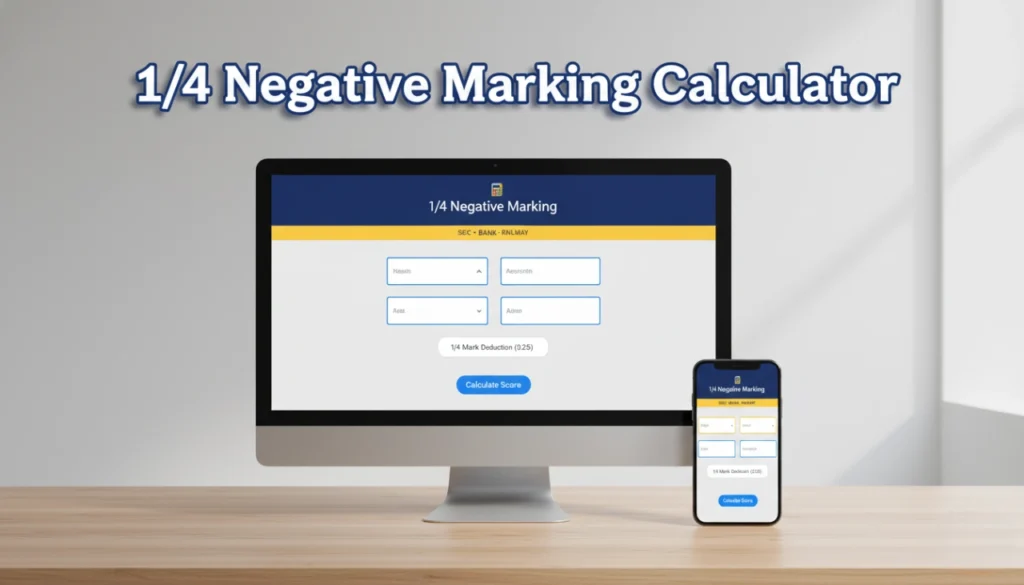
1/4 Negative Marking Calculator
Precise Scoring for Competitive Exams
Accurate 1/4 Negative Marking Exam Score Calculator
Competitive exams today are designed to measure not just knowledge but also accuracy. Many recruitment and entrance tests use a penalty system that deducts marks for incorrect answers. One of the most common penalty formats is 1/4 negative marking, where one-fourth of the question’s marks are deducted for every wrong answer.
Because penalties reduce your total score, calculating the final result can become confusing after a test. This is exactly where a 1/4 Negative Marking Calculator becomes useful. It helps you instantly calculate your real score by applying the correct deduction rule automatically.
What Is 1/4 Negative Marking?
In a 1/4 negative marking system, one-fourth (25%) of the marks assigned to a question are deducted if the answer is incorrect.
Example:
If one question carries 2 marks, then the penalty for a wrong answer will be:
2 × 1/4 = 0.5 marks deducted
So:
- Correct answer → full marks awarded
- Wrong answer → 25% of marks deducted
- Unattempted question → no deduction
This system is widely used in competitive exams such as SSC, banking exams, state recruitment tests, and many objective-based assessments.
Why Exams Use 1/4 Negative Marking
The main purpose of negative marking is to prevent random guessing. Without penalties, students could attempt every question and gain marks by chance. With deductions applied, candidates must answer carefully and confidently.
This improves fairness and ensures that rankings reflect real knowledge and accuracy.
At the same time, penalties make score calculation more complex. Simply counting correct answers is not enough. You must also subtract marks lost due to incorrect responses. A 1/4 Negative Marking Calculator handles this automatically and gives an accurate result instantly.
Example of 1/4 Negative Marking Calculation
Let’s understand with a practical example.
Exam Pattern
- Total questions = 100
- Marks per question = 2
- Questions attempted = 80
- Wrong answers = 20
- Negative marking = 1/4
Step 1 — Correct answers
\(\text{Correct} = 80 - 20 = 60\)Step 2 — Marks gained
\(\text{Marks Gained} = 60 \times 2 = 120\)Step 3 — Penalty
Penalty per wrong answer = 2 × 0.25 = 0.5
\(\text{Penalty} = 20 \times 0.5 = 10\)Step 4 — Final score
\(\text{Final Score} = 120 - 10 = 110\)Final exam score = 110 marks
How to Use the 1/4 Negative Marking Calculator
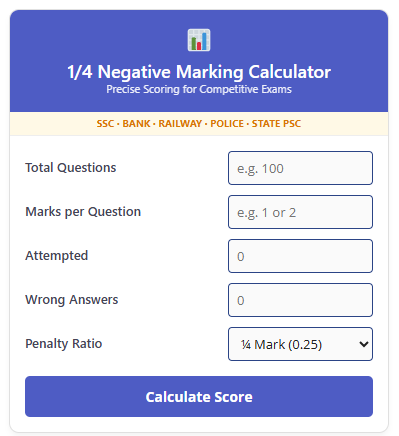
Using the calculator is simple and quick. You only need basic exam details.
Just follow these steps:
- Enter total number of questions in the exam.
- Enter maximum marks or marks per question.
- Enter number of questions attempted.
- Enter number of wrong answers.
- Select 1/4 negative marking ratio.
- Click calculate to get your final score instantly.
The calculator also shows:
- number of correct answers
- penalty marks
- accuracy percentage
- unattempted questions
This makes performance analysis easy after every mock test.
Where 1/4 Negative Marking Is Commonly Used
Many competitive exams use the 1/4 deduction system.
| Exam Type | Common Penalty |
|---|---|
| SSC Exams | 0.25 or 1/4 deduction |
| Banking Exams | 1/4 deduction |
| Some State Recruitment Exams | 1/4 deduction |
| Police & Defence Tests | Often 1/4 deduction |
| Objective Online Tests | Frequently 1/4 |
Always check the official exam pattern to confirm the exact ratio.
How 1/4 Negative Marking Affects Your Strategy
Penalty-based exams reward accuracy more than attempt count. Attempting too many questions without confidence can reduce your total score.
Smart strategy includes:
- answering high-confidence questions first
- avoiding blind guessing
- making logical guesses only when options can be eliminated
- focusing on accuracy instead of speed alone
Students who manage risk carefully usually score higher.
Tips to Score Better in 1/4 Negative Marking Exams
Small strategy changes can significantly improve your results.
✔ Read each question carefully before answering
✔ Attempt only when reasonably confident
✔ Eliminate incorrect options before guessing
✔ Practice mock tests regularly
✔ Check your real score after penalties
✔ Track accuracy percentage
✔ Reduce repeated mistakes
Consistent performance analysis leads to better results.
Benefits of Using a 1/4 Negative Marking Calculator
Using a calculator saves time and provides accurate performance analysis.
Key advantages include:
- instant score calculation
- no manual math errors
- accurate penalty deduction
- performance tracking
- strategy improvement
- realistic score prediction
Regular use helps you understand how accuracy affects ranking.
Who Should Use This Calculator?
The 1/4 Negative Marking Calculator is useful for:
- SSC aspirants
- banking exam candidates
- government job applicants
- students practicing mock tests
- anyone preparing for MCQ exams with penalty
- candidates predicting results before official announcement
It is helpful during preparation and after exams.
Comparison: 1/4 vs 1/3 vs 1/2 Negative Marking
| Negative Marking Type | Decimal Value | Penalty % | Marks Lost (If Question = 2 Marks) | Risk Level |
|---|---|---|---|---|
| 1/4 Negative Marking | 0.25 | 25% | 0.5 marks deducted | Low risk |
| 1/3 Negative Marking | 0.33 | 33.33% | 0.66 marks deducted | Medium risk |
| 1/2 Negative Marking | 0.50 | 50% | 1 mark deducted | High risk |
FAQs
What is a 1/4 Negative Marking Calculator?
A 1/4 Negative Marking Calculator is a tool that calculates your final exam score by deducting 25% of the question’s marks for every wrong answer. It helps you find your real score instantly without manual calculation.
How do I calculate my score with 1/4 negative marking?
First, calculate the number of correct answers. Then multiply correct answers by marks per question. After that, subtract the penalty for wrong answers (25% of marks per question). The remaining value is your final score.
Which exams use 1/4 negative marking?
Many competitive exams use this system, including SSC exams, banking exams, and some state recruitment tests. However, the exact rule depends on the specific exam pattern.
Does an unattempted question get negative marks?
No. If you leave a question unanswered, no marks are deducted. Negative marking applies only to incorrect answers.
Conclusion
The 1/4 negative marking system plays a major role in many competitive exams. It ensures fairness by rewarding accuracy and discouraging random guessing. At the same time, it makes score calculation more complex.
In competitive exams where small differences in marks can affect ranking, accurate score calculation becomes a powerful advantage.
