Space Age Calculator
Related
Space Age Calculator – Find Your Age on Other Planets
Have you ever wondered how old you would be on other planets? Time doesn’t move the same way across the solar system because each planet takes a different amount of time to orbit the Sun.
The Space Age Calculator helps you discover your age on Mercury, Venus, Mars, Jupiter, and beyond by comparing Earth years with real planetary years. Simply enter your birth details and explore how your age changes from planet to planet in a fun and easy way.
What is Space Age Calculator ?
A Space Age Calculator is an online tool that calculates how old a person would be on different planets in our solar system. Since each planet takes a different amount of time to orbit the Sun, a year is not the same length everywhere.
The calculator first finds your age in Earth years and then converts it into planetary years for Mercury, Venus, Mars, Jupiter, Saturn, Uranus, Neptune, and sometimes Pluto. In simple terms, it shows how your age changes in space compared to Earth, using real astronomical data in an easy and fun way.
How to Use the Space Age Calculator
Using the calculator is designed to be intuitive and fast. Follow these steps to generate your high-precision planetary report:
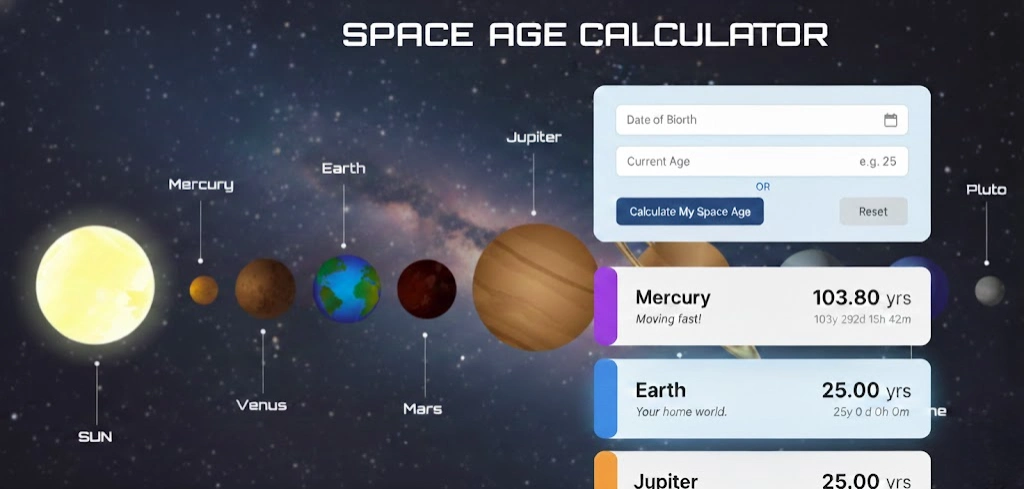
- Input Your Birth Data: You have two options. You can select your exact birth date using the calendar picker for maximum precision, or simply type your current Earth age (e.g., 25) into the numeric field.
- Trigger the Calculation: Click the “Calculate My Space Age” button. The tool will instantly process your age against the orbital velocities of the eight major planets.
- Analyze the Results: The list will populate with premium result cards. Each card displays your age as a decimal and provides a detailed breakdown of years, days, hours, and minutes specific to that planet.
- Reset for Others: Use the “Reset” button to clear the data and calculate the space age for friends or family members.
Key Features of this Space Age Calculator
This tool goes beyond basic multiplication to provide a premium data experience:
- Pill-Style Visual Identity: Each planet is assigned a specific color-coded vertical accent (e.g., Violet for Mercury, Emerald for Neptune) making the list easy to scan.
- High-Precision Logic: Unlike standard calculators that only show decimals, this tool calculates the remainder of your planetary year down to the minute.
- Mobile Optimization: The interface is built for “scannability,” ensuring that the complex data is legible on any screen size.
- Earth Context: The Earth card is highlighted to serve as your “origin point” for comparison.
Formula of Space Age Calculator
To calculate your age on another planet, we must first convert your Earth age into a neutral unit of time (milliseconds) and then divide it by the orbital period of the target planet.
The fundamental equation used is:
$$Age_{Planet} = \frac{Age_{Earth}}{Orbital Period_{Planet}}$$
Where the Orbital Period is the time (in Earth years) it takes for that planet to revolve around the sun. For example, to find your age on Mars, you would divide your Earth age by 1.8808.
Practical Example
If an individual is exactly 25 years old on Earth, here is how their age translates to a faster and a slower planet:
- On Mercury (Faster): Since Mercury orbits the sun in roughly 0.24 Earth years, the calculation is $25 / 0.2408$. This results in a Mercury age of 103.80 years.
- On Jupiter (Slower): Jupiter takes 11.86 Earth years to complete one orbit. The calculation is $25 / 11.8626$. This results in a Jupiter age of only 2.11 years.
Planetary Reference Table
This table provides the astronomical constants used by the calculator to ensure scientific accuracy.
| Planet | Orbital Period (Earth Years) | Speed Relative to Earth |
| Mercury | 0.2408 | ~4.1x Faster |
| Venus | 0.6152 | ~1.6x Faster |
| Earth | 1.0000 | Baseline |
| Mars | 1.8808 | ~0.5x Slower |
| Jupiter | 11.8626 | ~0.08x Slower |
| Saturn | 29.4474 | ~0.03x Slower |
| Uranus | 84.0168 | ~0.01x Slower |
| Neptune | 164.7913 | ~0.006x Slower |
Frequently Asked Questions
Why is my age so much higher on Mercury?
Mercury is the closest planet to the Sun. Because of the Sun’s gravity and its short path, it must travel much faster to stay in orbit, completing a year in just 88 Earth days.
What is a Galactic Year?
While this tool focuses on our solar system, a Galactic Year is the time it takes for our entire Solar System to orbit the center of the Milky Way galaxy—roughly 230 million years. You wouldn’t even be a second old in Galactic time!
Why does Venus have a Hottest Birthday subtitle?
Despite being further from the sun than Mercury, Venus has a thick atmosphere that traps heat, making it the hottest planet in our solar system.
How much time is 1 year in space?
How much time is 1 year in space?
There is no single length for 1 year in space.
A “year” depends on how long a planet takes to complete one orbit around the Sun.
For example:
Earth: 1 year = 365 days
Mercury: 1 year = about 88 Earth days
Neptune: 1 year = about 165 Earth years
So, 1 year in space changes based on the planet.
What is considered space age?
The term space age usually refers to:
The era that began with the launch of the first satellite (Sputnik in 1957)
Or, in calculators, it means your age measured using space or planetary time, not Earth time.
In simple words, space age = age calculated beyond Earth.
How long is 5 years in space compared to Earth?
Five years in space vary by planet because each one orbits the Sun at a different speed. On Mercury, five years equal about 1.2 Earth years, while on Venus they are around 3.1 Earth years. On Earth, five years stay 5 years, but on Mars they stretch to about 9.4 Earth years. Time becomes much longer on the outer planets: Jupiter ≈ 59 years, Saturn ≈ 147 years, Uranus ≈ 420 years, and Neptune ≈ 824 years. On Pluto, five years would take nearly 1,240 Earth years to pass.
Conclusion
The Space Age Explorer is more than just a novelty tool; it is a reminder of our place in a moving, dynamic solar system. By breaking down your age into precise years, days, and minutes, it highlights the vast differences in environment and time that exist just a few million miles away.