Decimal Age Calculator
The Guide to the Decimal Age Calculator
While most people celebrate their age once a year with cake and candles, time doesn’t actually move in yearly “jumps.” Time is a continuous, flowing stream. A Decimal Age Calculator is a precision tool designed to capture that flow, turning the abstract concept of “getting older” into a high-precision mathematical reality.
What Exactly is Decimal Age?
In standard conversation, we use chronological age (e.g., “I am 28 years old”). This is a discrete measurement. Decimal age, however, is a continuous measurement. It represents your age as a single number where the integer is the year and the decimal represents the exact portion of the current year you have completed.
For example, if you are exactly halfway between your 28th and 29th birthday, your decimal age is 28.5000.
The Mathematical Formula of Decimal Age Calculator
To calculate this with scientific accuracy, we use the Mean Tropical Year. Because the Earth takes slightly longer than 365 days to orbit the sun, we use a constant that accounts for leap year cycles:
$$Age_{decimal} = \frac{\text{Current Time} – \text{Birth Time}}{\text{Average Milliseconds in a Year}}$$
In our calculator, the denominator is 31,556,952,000 milliseconds (which represents the 365.2425-day cycle of the Gregorian calendar).
Why Precision Age Matters
Why would someone need to know their age to ten decimal places? Beyond the fascination of watching your life tick away in real-time, decimal age is used in several professional fields:
1. Pediatrics and Developmental Research
Children grow at an incredible rate. In medical studies, comparing a child who is 4.1 years old to one who is 4.9 years old is vital. Using decimal age allows researchers to plot growth charts on a smooth curve rather than a jagged step-graph.
2. Sports Science and Talent Identification
In youth sports, the “Relative Age Effect” is a major factor. A child born in January (decimal age 10.9) often has a massive physical advantage over a teammate born in December (decimal age 10.1). Coaches use decimal calculators to normalize performance data.
3. Actuarial and Financial Modeling
Insurance companies and pension funds use decimalized time to calculate risk and life expectancy. Precise “time-at-risk” models require more than just a birth year to be accurate.
Beyond the Numbers: Life Metrics Explained
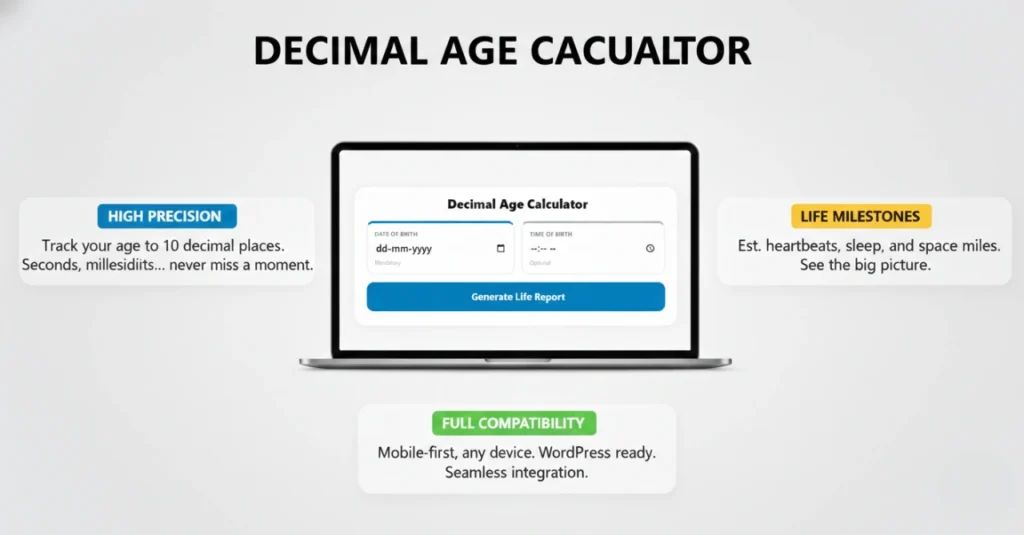
Our Precision Age Dashboard doesn’t just show a decimal; it translates that number into a comprehensive “Life Report.”
Human-Readable Breakdown
While the decimal is scientific, we still think in blocks. The calculator breaks your life down into Years, Months, and Days to give you a grounded sense of your timeline.
Total Life Totals
Seeing your life in smaller units can be eye-opening.
- Total Days: How many sunrises you have witnessed.
- Total Seconds: A reminder of how many “moments” have passed.
Biological Estimates
By applying average constants to your decimal age, we can estimate incredible milestones:
- Heartbeats: Based on an average of 80 beats per minute, you can see how hard your heart has worked for you.
- Sleep Time: Humans spend roughly 33% of their lives asleep. Our tool calculates how many “years” you’ve spent in the dream world.
How to Get the Most Accurate Result
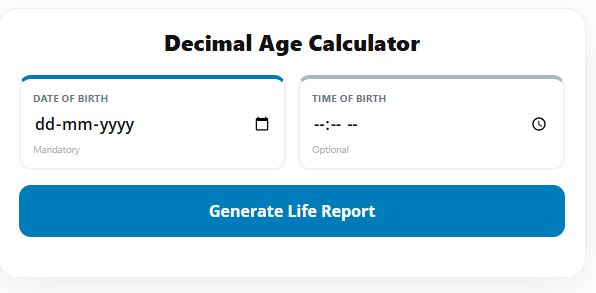
To achieve True Precision, follow these steps:
- Find your birth certificate: Most people know their birthday, but few know their exact Time of Birth.
- Input the Time: Entering the exact hour and minute allows the decimal clock to sync perfectly with your biological arrival.
- Watch the Ticker: Because the clock uses
requestAnimationFrame, it updates at the refresh rate of your monitor, showing you the literal passage of your life in real-time.
Features of the Calculator
Our tool provides a 360-degree view of your life’s timeline. Here is a breakdown of the metrics provided:
| Metric | Description |
| Live Decimal Clock | A 10-digit real-time counter showing your age as a mathematical constant. |
| Human Summary | Converts the data back into the familiar “Years, Months, Days” format. |
| Life Estimates | Uses statistical averages to estimate total heartbeats (approx. 80 BPM) and sleep (approx. 1/3 of life). |
| Birthday Progress | A visual track showing exactly how far you are through your current trip around the sun. |
To fully understand how a Decimal Age Calculator works, you have to see how it converts “calendar time” into “mathematical time.”
The table below illustrates a complete conversion for a person born on May 20, 1990, at 6:00 AM, as calculated on February 7, 2026.
1. The Conversion Workflow: From Birth to Decimal
This table follows the logic of the calculator from the moment of input to the final live display.
| Step | Component | Value/Data | Logic Used |
| 1 | Start Point | May 20, 1990 (06:00) | The User’s Birth Input. |
| 2 | End Point | Feb 7, 2026 (21:30) | The “Current Moment” (Now). |
| 3 | Elapsed MS | $1,127,143,800,000$ | Total milliseconds between both dates. |
| 4 | Year Constant | $31,556,952,000$ | The average milliseconds in 1 solar year. |
| 5 | The Division | Step 3 ÷ Step 4 | Calculating how many years fit in that time. |
| FINAL | Decimal Age | 35.7177559124 | The final, precise mathematical result. |
2. Full “Life Report” Summary Table
Once the decimal is calculated, it is broken back down into these specialized categories.
| Category | Metric | Result |
| Traditional | Chronological Age | 35 Years, 8 Months, 18 Days |
| Astronomy | Zodiac Sign | Taurus ♉ |
| Astronomy | Solar Orbits | 35.72 Orbits completed around the Sun. |
| Biology | Est. Heartbeats | 1,502,858,400 (at 80 BPM) |
| Biology | Est. Sleep | 11.90 Years (at 8 hrs/day) |
| Time Units | Total Days | 13,046 Days |
| Time Units | Total Minutes | 18,785,730 Minutes |
3. Understanding the Decimal Digits
If you are looking at the calculator’s 10-digit display, this is what each section of that number tells you about your life progress:
| Digit Position | Value in Example | What it represents |
| Whole Number | 35. | Your completed years. |
| 1st Decimal | .7 | Large chunks of the year (Months). |
| 2nd – 3rd | .71 | Smaller chunks (Weeks/Days). |
| 4th – 6th | .7177 | Daily progress (Hours/Minutes). |
| 7th – 10th | .7177559124 | The Live Ticker: Seconds and milliseconds passing. |
4. Comparison Table: Why Time of Birth Matters
The decimal age changes significantly if you know your exact birth time versus just the date.
| Scenario | Time Input | Decimal Age Result |
| Date Only | 00:00 (Midnight) | $35.718451…$ |
| Exact Time | 06:00 (Morning) | $35.717755…$ |
| Difference | 6 Hours | 0.000696 (The precision gap) |
FaQs
What is a Decimal Age Calculator?
A Decimal Age Calculator is a high-precision tool that converts your age from traditional years, months, and days into a single continuous number (a decimal).
While a standard calendar tells you that you are “25 years old,” this calculator shows you exactly where you stand in your current year—for example, 25.4128930412.
How is the decimal part of the age calculated?
The calculator determines the total number of milliseconds elapsed since the moment of your birth and divides that by the average length of a year in milliseconds.
We use the Gregorian Year average, which is:
$$365.2425 \text{ days} = 31,556,952,000 \text{ milliseconds}$$
Why does the decimal age constantly change?
Because time is continuous! Our calculator uses a “Live Ticker” (powered by requestAnimationFrame). This means the last 4 to 5 digits of the decimal represent the seconds and milliseconds passing in real-time. As you watch the screen, you are literally watching your age increase.
Why should I include my Time of Birth?
Including your birth time increases the accuracy of the calculation by several decimal places. Without a time, the calculator defaults to midnight (00:00). If you were actually born at 8:00 PM, your decimal age would be off by approximately 0.0022, which represents 20 hours of life.
What is the Relative Age Effect (RAE)?
This is a scientific concept often analyzed using decimal age. In sports and education, children born earlier in the year (e.g., a 10.9 decimal age) are often more physically and cognitively developed than those born later (e.g., a 10.1 decimal age), even though they are in the same “age group.”