Negative Marking Calculator
Smart Scoring & Strategy
Negative Marking Calculator for UPSC, NEET, SSC, JEE, RRB – Find Your Real Score After Deduction
Preparing for competitive exams like UPSC, NEET, SSC, JEE, and RRB requires more than just answering questions correctly — accuracy plays an equally important role. Most of these exams follow a negative marking system, where marks are deducted for incorrect answers. Because of this, estimating your real score after a test can be confusing and time-consuming.
A Negative Marking Calculator makes this process simple. It helps you instantly calculate your final exam score after applying penalty marks for wrong answers. Instead of guessing your result or doing manual calculations, you can quickly see how many marks you gained, how many you lost, and what your actual performance looks like.
This tool is especially useful for mock tests, practice sessions, and score prediction before official results. By understanding how negative marking affects your score, you can plan smarter strategies and improve accuracy in future exams.
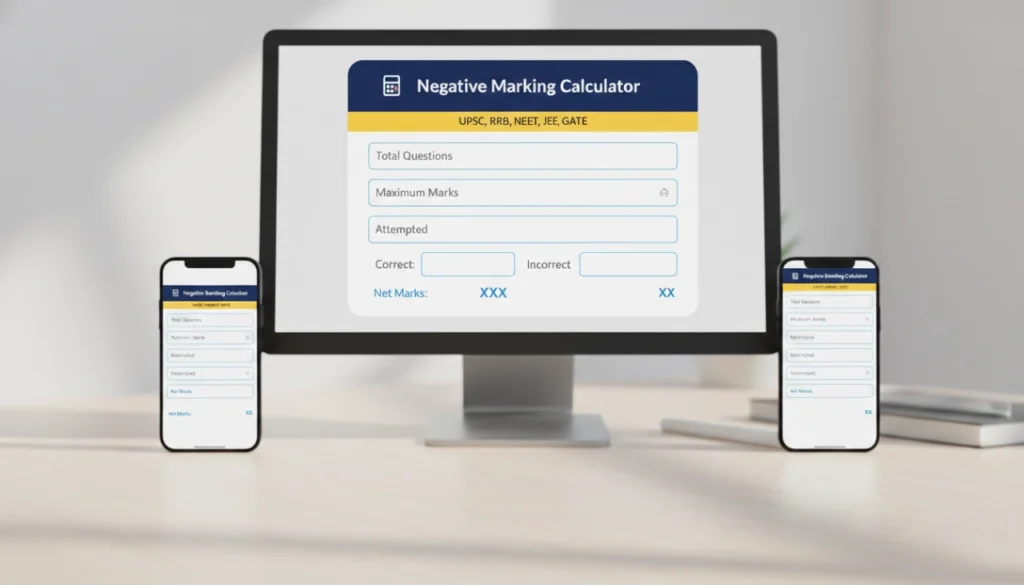
A Negative Marking Calculator solves this problem by automatically calculating your final score after penalties are applied. Instead of manual calculations, you get instant and accurate results. This helps you understand your real performance and prepare more effectively for upcoming exams.
What Is Negative Marking and Why Is It Used?
Negative marking is a scoring rule that deducts marks for wrong answers. It is commonly used in objective exams to discourage random guessing and reward confident knowledge.
Without penalties, candidates could attempt every question blindly and still score well by chance. Negative marking ensures fairness by rewarding accuracy rather than guesswork.
Because deductions affect total marks significantly, students often rely on tools like a marks deduction calculator for exams to see exactly how much score they lose due to incorrect responses.
How Negative Marking Affects Your Exam Score
In most exams, each correct answer gives full marks, while each wrong answer leads to a deduction. The deduction is usually a fraction of the marks assigned to that question.
Example scoring pattern:
- Correct answer = +2 marks
- Wrong answer = −0.5 marks
This means your final score depends on:
- correct answers
- incorrect answers
- penalty ratio
Students often try to calculate exam marks with negative marking after a test to estimate their real result. Since multiple factors are involved, using a calculator makes the process faster and more accurate.
Formula Used in Negative Marking Calculation
All scoring systems follow the same mathematical structure. First, calculate correct answers. Then calculate marks gained. Finally, subtract penalties.
Step 1 – Correct answers
\(\text{Correct Answers} = \text{Attempted Questions} - \text{Wrong Answers}\)Step 2 – Marks gained
\(\text{Marks from Correct Answers} = \text{Correct Answers} \times \text{Marks per Question}\)Step 3 – Penalty marks
\(\text{Penalty Marks} = \text{Wrong Answers} \times \text{Negative Marks per Question}\)Step 4 – Final score
\(\text{Final Score} = \text{Marks from Correct Answers} - \text{Penalty Marks}\)This is the same logic used in any score calculator with negative marking or negative marks formula calculator.
How to Use a Negative Marking Calculator
Using a calculator is simple and saves time. Most students use it right after finishing a mock test.
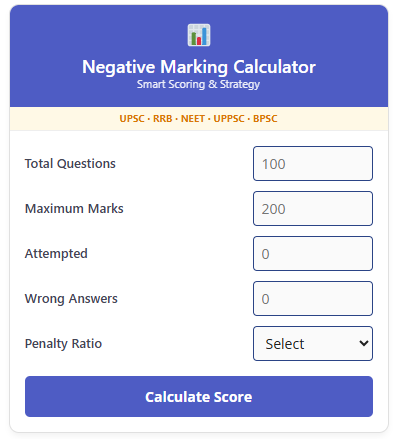
Here’s how to use it easily:
- Enter total number of questions in the exam
- Enter marks given for each correct answer
- Enter how many questions you attempted
- Enter number of wrong answers
- Enter the negative marking value used in the exam
- Click calculate to get your final score instantly
Many aspirants use an MCQ negative marking calculator regularly to track performance and reduce mistakes over time.
Solved Example of Score Calculation
Let’s understand with a realistic exam scenario.
Exam pattern:
- Total questions = 100
- Marks per correct answer = 2
- Negative marking = 0.5
- Questions attempted = 80
- Wrong answers = 15
Step 1 — Correct answers
\(\text{Correct} = 80 - 15 = 65\)Step 2 — Marks gained
\(\text{Marks Gained} = 65 \times 2 = 130\)Step 3 — Penalty
\(\text{Penalty} = 15 \times 0.5 = 7.5\)Step 4 — Final score
\(\text{Final Score} = 130 - 7.5 = 122.5\)This is the actual score used in ranking.
Reference Table – Negative Marking in Popular Competitive Exams
Different exams use different penalty ratios. Always use the correct marking rule for accurate calculation.
| Exam | Marks per Correct | Negative Marking |
|---|---|---|
| UPSC Prelims | 2 | 0.66 (1/3 deduction) |
| SSC Exams | 2 | 0.25 or 0.5 |
| Banking Exams | 1 | 0.25 |
| NEET | 4 | 1 mark deduction |
| JEE Main | 4 | 1 mark deduction |
| Railway Exams | 1 | 0.33 deduction |
Because scoring rules differ, many students use a competitive exam score calculator with penalty settings specific to their exam.
Why Score Prediction Helps in Exam Preparation
Knowing your real score after each mock test helps you understand your preparation level clearly. Many students feel confident after attempting many questions, but penalties may reduce the total more than expected.
Using an exam negative marking calculator regularly helps you:
- track improvement over time
- identify weak topics
- understand accuracy trends
- refine attempt strategy
Accurate score analysis leads to smarter preparation.
How Negative Marking Influences Exam Strategy
Penalty-based exams reward accuracy more than attempt count. Attempting many questions with low confidence can reduce your score.
Students who understand scoring systems become more selective. They skip doubtful questions and focus on high-confidence answers. Over time, this improves overall performance.
Using a negative marks formula calculator helps students see how different attempt patterns affect their final score, making strategy planning easier.
Tips to Score Better in Negative Marking Exams
Negative marking exams require smart decision-making along with knowledge.
- Attempt confident questions first
- Avoid blind guessing
- Make logical guesses only after eliminating options
- Maintain accuracy instead of chasing attempts
- Practice mock tests regularly
- Analyze penalty marks after every test
- Learn from mistakes and reduce repeated errors
Students who control risk usually score higher than those who attempt everything.
Who Should Use a Negative Marking Calculator?
This tool is useful for anyone appearing in penalty-based exams, including:
- competitive exam aspirants
- government job candidates
- students taking MCQ tests
- mock test practice learners
- anyone predicting exam scores
- students improving accuracy and strategy
Regular score calculation helps you understand your true performance level.
Negative Marking Ratios Major Exams In India
| UPSC Prelims | 2 marks | 0.66 marks deducted | 1/3 of marks |
| NEET (UG) | 4 marks | 1 mark deducted | 1/4 of marks |
| SSC Exams | 2 marks (usually) | 0.5 or 0.25 deducted | 1/4 or fixed |
| JEE Main | 4 marks | 1 mark deducted | 1/4 of marks |
| RRB Exams | 1 mark | 0.33 deducted | 1/3 of marks |
| CUET (UG) | 5 marks | 1 mark deducted | 1/5 of marks |
| Banking Exams (IBPS, SBI) | 1 mark | 0.25 deducted | 1/4 of marks |
| State PSC Exams | Varies | Usually 1/3 deduction | 1/3 of marks |
FAQs
What is a Negative Marking Calculator?
It is a tool that calculates final exam scores by subtracting penalty marks for wrong answers.
Why do exams use negative marking?
It prevents guessing and rewards accurate knowledge.
How do I calculate my score with negative marking?
Calculate marks from correct answers, subtract penalty for wrong answers, and you get the final score.
Does attempting more questions increase score?
Not always. Low accuracy can reduce marks due to penalties.
Is negative marking the same in every exam?
No. Each exam has its own penalty ratio.
Conclusion
Negative marking can significantly affect your exam score, so accuracy is just as important as the number of correct answers. A Negative Marking Calculator for UPSC, NEET, SSC, JEE, and RRB helps you quickly calculate your real score after penalty deductions. It saves time, prevents calculation mistakes, and helps you understand your true performance, making your exam preparation smarter and more effective.
Related Calculator
