Ratio Calculator with Steps
How to Use the Advanced Ratio Calculator
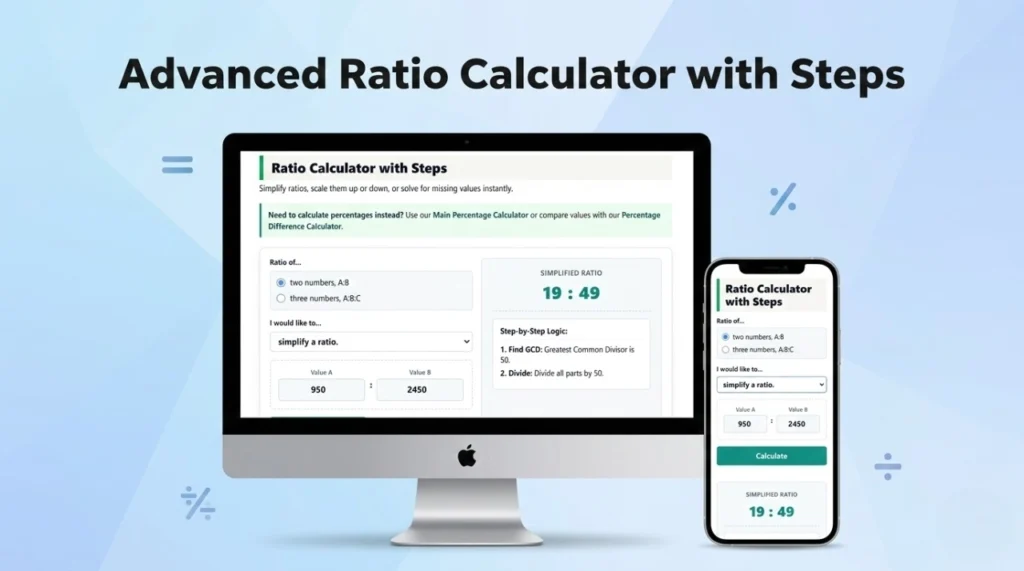
This calculator is designed to handle multiple ratio scenarios. First, select whether you are working with a standard two-part ratio (A:B) or a three-part ratio (A:B:C). Then, choose your calculation mode:
- Find an equivalent ratio: Use this mode to solve for an unknown variable. Enter your known ratio, and on the other side of the equation, leave exactly one box blank (for X) and fill in the rest.
- Make a ratio larger / smaller: Enter your base ratio and a multiplier (or divisor) to scale your ratio up or down proportionally. Perfect for adjusting cooking recipes.
- Simplify a ratio: Reduces large numbers to their lowest common denominator automatically.
- Simplify to a 1:n form: Forces the first number to become a 1, adjusting the rest of the ratio as a decimal. Highly useful in map scales or odds calculations.
What is a Ratio?
A ratio is a mathematical relationship comparing the quantity of two or more things. It indicates how many times one number contains another. For example, if a bowl of fruit contains 8 oranges and 6 lemons, the ratio of oranges to lemons is 8 to 6 (which can be simplified to 4 to 3).
Ratios can be written in three distinct ways:
- With a colon: 4 : 3
- Using the word “to”: 4 to 3
- As a standard fraction: 4 / 3
Mathematical Formulas Used
Simplifying Ratios (The GCD Method)
To reduce a ratio to its simplest form, the calculator finds the Greatest Common Divisor (GCD). This is the largest whole number that divides evenly into all parts of the ratio.
Example: Simplify 20 : 25.
The GCD of 20 and 25 is 5.
Divide both sides by 5: (20 ÷ 5) : (25 ÷ 5) = 4 : 5.
Solving Equivalent Ratios (Cross-Multiplication)
If you are trying to find an equivalent ratio (A : B = C : D) and one number is missing, you use the rule of cross-multiplication: A × D = B × C.
Solving for B → B = (A × D) / C
Solving for C → C = (A × D) / B
Solving for D → D = (B × C) / A
FaQs
What is a ratio in math?
A ratio is a mathematical comparison between two or more numbers showing how many times one value contains another. It is usually written in the form A:B or A to B.
How do you simplify a ratio?
To simplify a ratio, find the Greatest Common Divisor (GCD) of the numbers and divide each part of the ratio by that number. The result is the ratio in its simplest form.
What is an equivalent ratio?
An equivalent ratio is a ratio that represents the same relationship between numbers. You can create equivalent ratios by multiplying or dividing both parts of the ratio by the same number.
How do you convert a ratio to a fraction?
A ratio A:B can be written as the fraction A/B. For example, the ratio 3:4 can be expressed as the fraction 3/4.
How do you convert a ratio into a percentage?
First convert the ratio to a fraction, then multiply by 100 to get the percentage.
Example: 2:5 → 2/5 → (2 ÷ 5) × 100 = 40%.
How do you compare two ratios?
Convert both ratios into fractions or decimals and compare their values. The ratio with the larger value represents the greater proportion.
Can a ratio have three numbers?
Yes, ratios can compare three or more numbers. For example, 2:3:5 compares three quantities.
What is the difference between ratio and proportion?
A ratio compares two numbers, while a proportion states that two ratios are equal, such as 2:3 = 4:6.
How to calculate a ratio step by step?
To calculate a ratio, follow these steps:
1. Write the numbers in ratio form (A:B).
2. Find the GCD (Greatest Common Divisor) of both numbers.
3. Divide each number by the GCD.
4. The result is the simplified ratio.
Example: For 20 and 30 → GCD = 10 → 20÷10 : 30÷10 = 2 : 3.
What is the ratio of 375 to 475?
Write the ratio as 375 : 475.
The GCD of 375 and 475 is 25.
Divide both numbers by 25:
375 ÷ 25 = 15
475 ÷ 25 = 19
So, the simplified ratio is 15 : 19.