Box Profile Weight Calculator
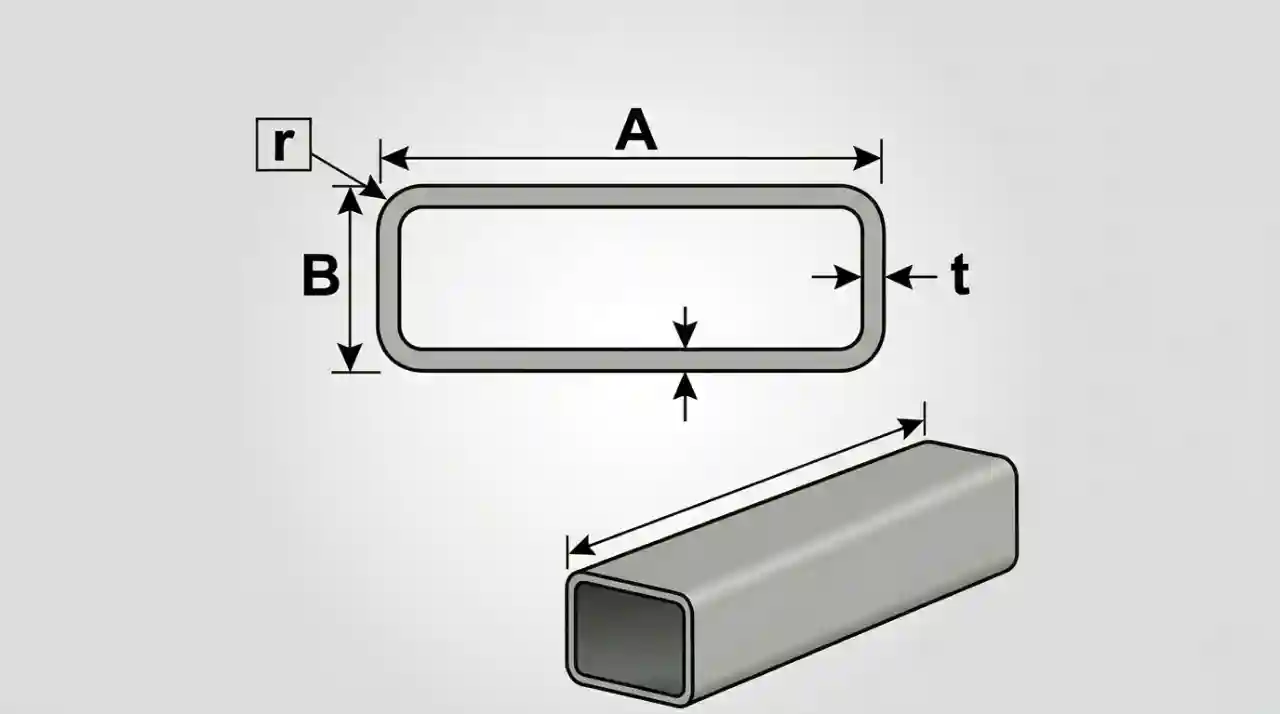
Dimensions
Material
The Ultimate Box Profile Weight Calculator: Exact Math for SHS & RHS Sections
Whether you are quoting a large-scale structural steel job, managing logistics for freight, or buying raw stock for a custom fabrication project, guessing the weight of your materials is a costly mistake. Overestimating leads to lost bids and wasted money, while underestimating can result in structural failures or shipping penalties.
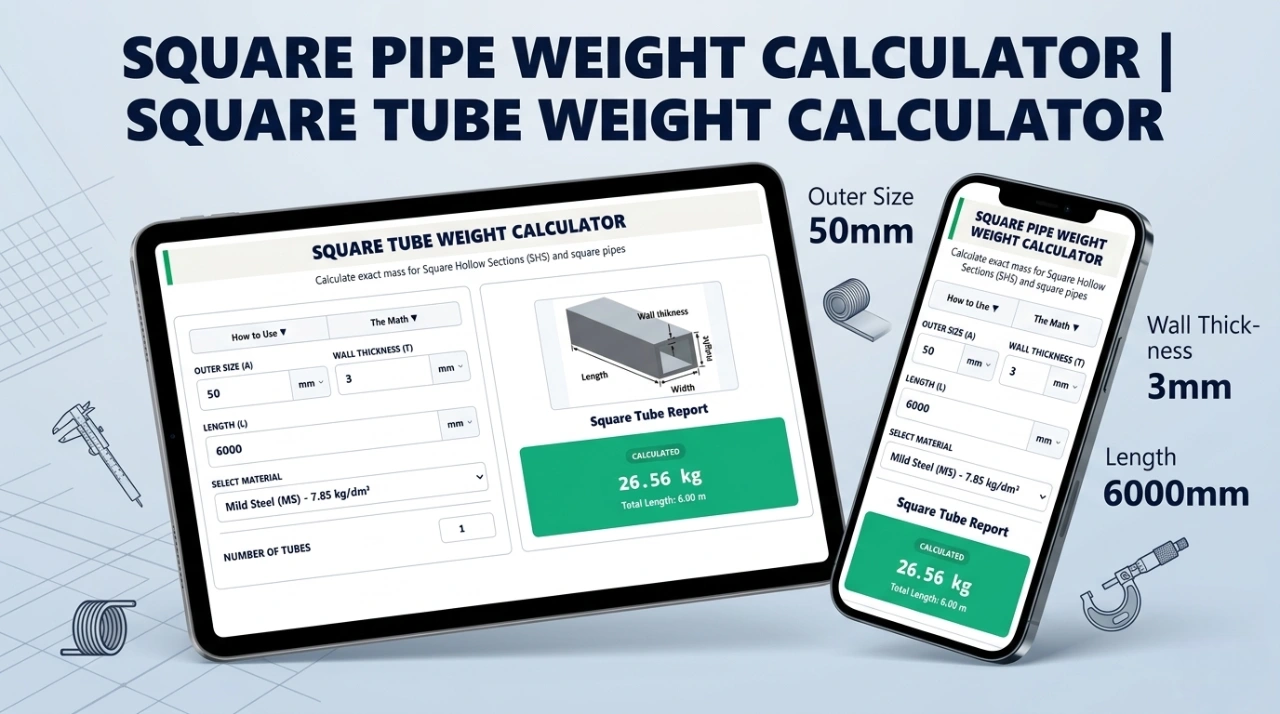
Our Box Profile Weight Calculator is an advanced engineering tool designed to give you the exact weight of Square Hollow Sections (SHS) and Rectangular Hollow Sections (RHS). Unlike basic calculators that use flawed, simplified geometry, this tool factors in precise corner radii and exact material densities across 20 different metals and polymers.
What is a Box Profile (SHS & RHS)?
In metalworking and structural engineering, a "box profile" refers to metal tubing with a square or rectangular cross-section.
- SHS (Square Hollow Section): Tubing where the width and height are identical. It provides uniform strength and is highly resistant to torsion (twisting).
- RHS (Rectangular Hollow Section): Tubing where the width and height differ. It is typically used when stress is applied in a specific direction, acting much like an I-beam but with a cleaner architectural finish.
Both profiles are staples in construction, automotive frames, agricultural equipment, and general fabrication.
Why "Simple" Calculators Get It Wrong: The Corner Radius Factor
If you search for a "steel tube weight calculator," you will find dozens of basic tools. The problem? Most of them assume the tubing has perfectly sharp, 90-degree corners. In reality, the manufacturing processes used to roll and weld hollow sections create rounded corners. A sharp corner creates a weak point susceptible to cracking, so structural tubing is deliberately formed with an outer and inner radius.
By assuming a sharp 90-degree corner, basic calculators include "phantom material" that doesn't actually exist, overestimating the total cross-sectional area and the final weight.
The Exact Geometric Math
Our calculator applies real-world manufacturing mathematics. We calculate the precise area by determining the outer boundary and subtracting the empty inner boundary, applying the exact mathematical formula for rounded corners:
Cross-Sectional Area = (Width × Height) – Unused Corner Space
By default, our tool uses an "Auto" radius set to twice the wall thickness ($2t$), which is the industry standard for cold-formed structural hollow sections. However, if your supplier uses a custom forming die, you can manually enter your exact corner radius for ultimate precision.
How to Use the Box Profile Weight Calculator
We built this tool to eliminate the friction of unit conversions and manual handbook lookups. Here is how to get your results in seconds:
- Enter Your Dimensions: Input the outer Width (A) and outer Height (B) of your profile. For a square tube, simply enter the same number in both fields.
- Define Wall Thickness (t): Enter the gauge or thickness of the material wall.
- Set Corner Radius (r): Leave this blank to use the standard "Auto" calculation ($2 \times t$), or manually input your specific radius.
- Choose Your Length (L): Enter the cut length of your pieces.
- Seamless Unit Conversion: Our tool supports millimeters (mm), centimeters (cm), meters (m), and inches (in). You can mix and match. If you change a unit dropdown, the calculator will instantly convert all your current values, ensuring your layout stays mathematically consistent.
- Select Your Material: Choose from our database of 20 industrial materials, including Steel, Aluminum, Brass, and specialty polymers.
- Calculate: Enter the number of pieces required, hit calculate, and get your exact total weight in kilograms.
Supported Materials and Densities
Different applications require different materials, and the density of that material drastically changes your final weight. All our internal calculations use precise $kg/dm^3$ density metrics to guarantee accuracy.
- Structural & Carbon Metals: * Steel (St37): 7.85 kg/dm³
- Stainless Steel: 7.90 kg/dm³
- Cast Iron: 7.20 kg/dm³
- Lightweight & Architectural Metals: * Aluminum: 2.70 kg/dm³ (Ideal for high strength-to-weight ratios)
- Brass: 8.50 kg/dm³
- Bronze: 8.80 kg/dm³
- Copper: 8.96 kg/dm³
- Specialty & Precious Metals: * Titanium: 4.51 kg/dm³
- Lead: 11.34 kg/dm³
- Zinc: 7.14 kg/dm³
- Gold: 19.32 kg/dm³
- Engineering Plastics: * Teflon (PTFE): 2.20 kg/dm³
- Polycarbonate: 1.20 kg/dm³
- Nylon (PA6): 1.15 kg/dm³
Who Should Use This Box Profile Calculator Tool?
- Metal Fabricators and Welders: Accurately quote material costs and determine if a completed assembly can be safely lifted with your shop crane.
- Structural Engineers: Verify dead loads and dead weights when drafting architectural frameworks and support columns.
- Logistics and Shipping Managers: Ensure freight shipments of SHS/RHS bundles remain under maximum Department of Transportation (DOT) payload capacities.
- DIY Builders & Hobbyists: Determine if your home workbench, trailer chassis, or off-road bumper design will be too heavy for your vehicle to handle.
Frequently Asked Questions (FAQ)
How do I calculate the weight of a square steel tube manually?
To calculate it manually, you must find the volume of the steel and multiply it by its density. Find the volume by calculating the outer rectangular volume minus the inner empty volume. Multiply that volume (in cubic decimeters) by the density of steel (approximately 7.85 kg/dm³). Our tool automates this entirely, while also factoring in the rounded corners for higher accuracy.
What is the standard corner radius for steel box profiles?
For most standard cold-formed hollow sections, the outer corner radius is approximately 2.0 to 2.5 times the wall thickness (2t).
Does wall thickness affect the outer dimensions?
No. The outer dimensions (Width A and Height B) remain constant. As wall thickness increases, the inner dimensions shrink, making the hole in the center smaller and the profile much heavier.
Why is my calculated weight slightly different from my supplier's catalog?
Supplier catalogs often provide a "theoretical weight" that accounts for manufacturing tolerances. Steel mills have a permissible rolling tolerance (usually $\pm 5$%). Additionally, if your supplier uses a slightly different corner radius or a specific steel alloy with a marginally different density, minor variations will occur. Our calculator provides the exact geometric weight.
Site Sources
- Material Densities: Material property data is sourced from MatWeb, the industry-standard database for engineering material specifications.
- Geometric Formulas & Standards: Structural calculations and hollow section engineering principles are based on reference data from The Engineering ToolBox.