SS PIPE WEIGHT CALCULATOR
Calculate exact weight for Stainless Steel pipes and tubes (304, 316, 430)
- Enter the Outer Diameter (OD) of the stainless pipe.
- Enter the Wall Thickness (t). Seamlessly change units if needed.
- Enter the Length (L) of the pipe.
- Select your specific SS Grade (304 or 316) and click “Calculate”.
Precision Math: Stainless steel grades have slightly different densities. SS 304 is typically 7.93 kg/dm³, while SS 316 (containing Molybdenum) is slightly heavier at 7.98 kg/dm³.
SS Pipe Report
| Material Grade | — |
| Dimensions (OD x t) | — x — |
| Weight per Meter | — kg/m |
| Pieces | — |
The Ultimate Stainless Steel Pipe Weight Calculator
Stainless Steel (SS) pipes and tubes are critical components in industries requiring high corrosion resistance and sanitation, such as food processing, pharmaceuticals, petrochemicals, and marine engineering. Because stainless steel is a premium, high-cost alloy, calculating the exact weight of your materials before quoting a job or ordering stock is absolutely essential to protect your profit margins.
Our interactive SS Pipe Weight Calculator is engineered to provide flawless theoretical weight estimates for all major stainless steel grades, including 304, 316, and 400 series alloys. It functions as a complete Steel Pipe Weight Calculator, allowing you to seamlessly swap between Mild Steel and Stainless Steel to compare mass and logistics costs.
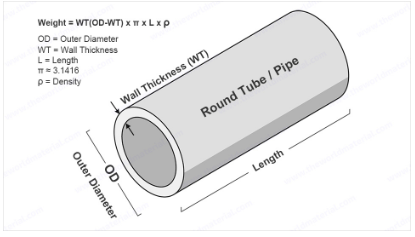
The SS Pipe Weight Formula
To calculate the theoretical mass of a seamless or welded stainless steel pipe manually, you must calculate the volume of the cylindrical wall and multiply it by the specific density of the alloy. Whether you are using an SS Tube Weight Calculator or a pipe calculator, the universal industrial formula remains the same:
Why Stainless Steel Grades Matter (304 vs. 316)
Unlike standard mild steel which has a uniform density of 7.85 kg/dm³, stainless steel densities vary slightly based on their elemental composition (the amount of Chromium, Nickel, and Molybdenum present). If you use a basic Pipe Weight Calculator Online that treats all steel equally, your estimates for a large pipeline project will be inaccurate.
| Stainless Steel Grade | Density ($kg/dm^3$) | Common Applications |
|---|---|---|
| SS 304 / 304L | 7.93 | Food grade, brewing, general architecture |
| SS 316 / 316L | 7.98 | Marine environments, chemical processing (added Molybdenum) |
| SS 410 / 430 | 7.70 | Automotive exhaust, decorative trim (Ferritic/Martensitic) |