PH CONCENTRATION CALCULATOR
Accurately determine the hydrogen ion concentration [H+] from pH
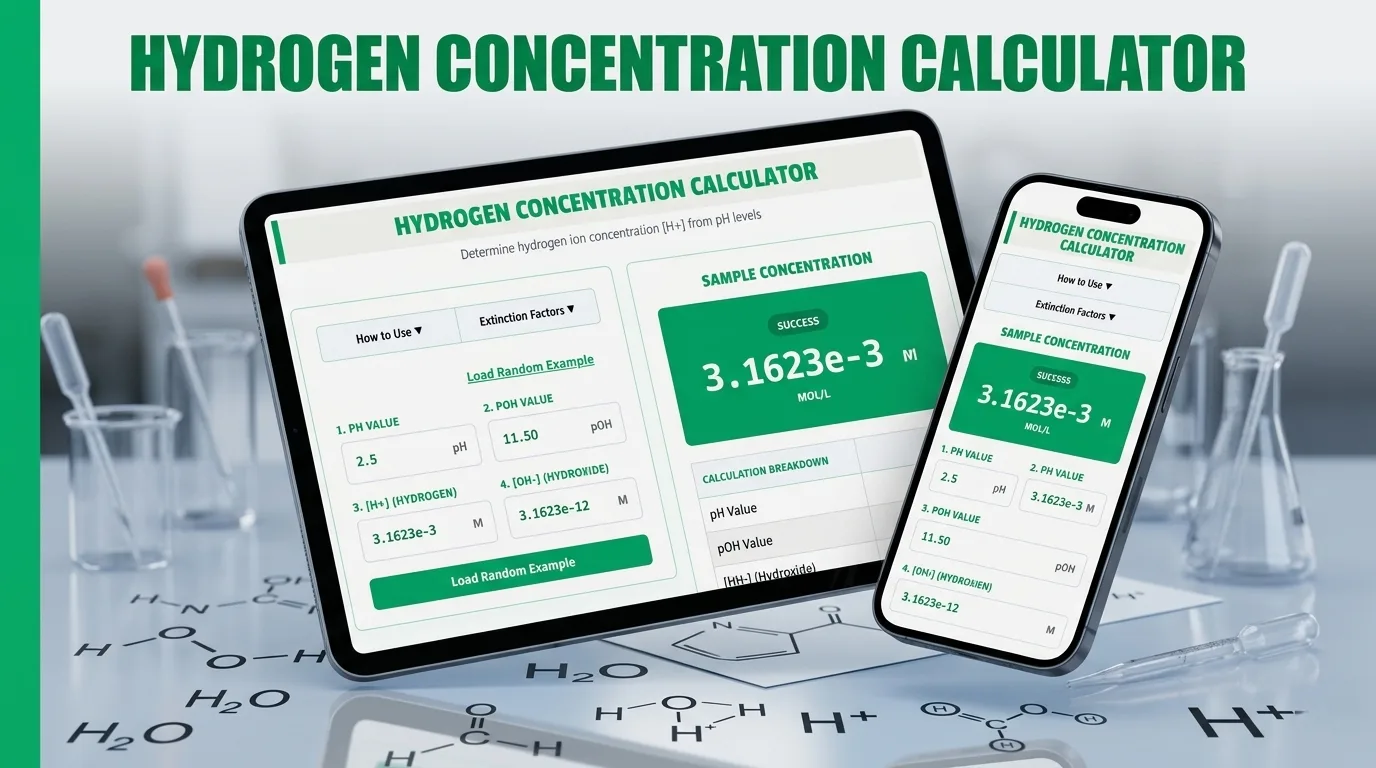
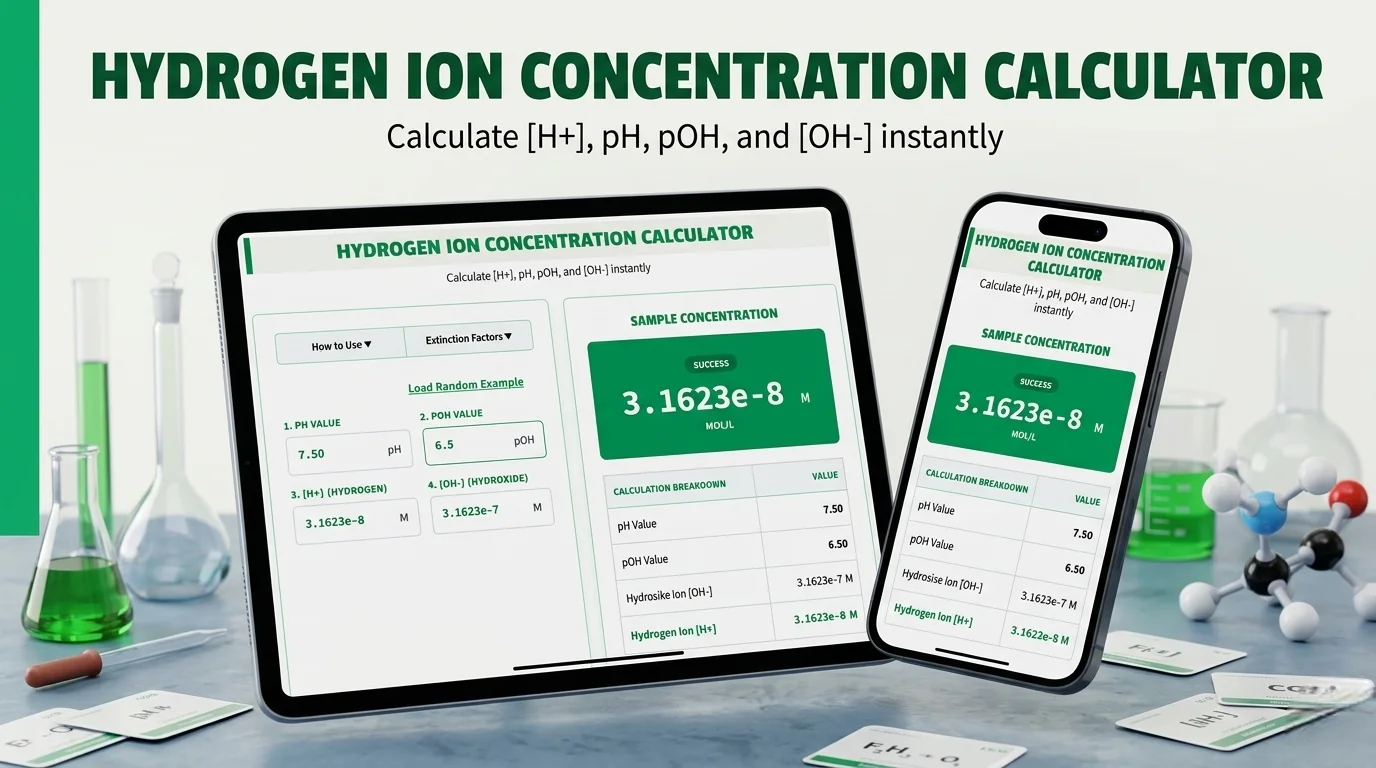
- Enter Any Value: You can input the pH, pOH, Hydrogen Ion [H+], or Hydroxide Ion [OH-] concentration.
- Auto-Sync: As soon as you type in one box, the other three boxes will automatically calculate and fill in.
- Scientific Notation: For very small numbers like 0.0000001, you can type “1e-7”.
- Results update automatically to display the calculated concentrations in Moles per Liter (M).
Standard pH Formulas:
- pH + pOH = 14
- [H+] = 10-pH
- [OH-] = 10-pOH
- Note: A pH of 7.0 is considered neutral at 25°C.
Sample Concentration
| Calculation Breakdown | Value |
|---|---|
| Awaiting inputs… | – |
- What is pH Concentration?
- Why is pH Concentration Important in Molecular Biology?
- pH Concentration Calculator Formula
- How to Calculate pH Concentration (Step-by-Step)
- pH Concentration Using A260 Method
- pH Concentration Units (ng/µL, µg/mL Explained)
- Example Calculation of pH Concentration
- DNA Molarity vs Concentration – Key Differences
- Factors Affecting pH Concentration Accuracy
- Common Methods to Measure pH Concentration
- pH Concentration Conversion (ng/µL to µg/mL)
- Applications of pH Concentration in Lab Experiments
- Common Mistakes in pH Concentration Calculation
- FAQs About pH Concentration Calculator
Calculations are based on the standard Beer-Lambert Law principles and widely accepted extinction coefficients for nucleic acid quantification in molecular biology workflows.
What is pH Concentration?
ph concentration refers to the amount of genetic material (nucleic acid) present in a specific volume of solution. Following a DNA extraction procedure, researchers must determine this metric to understand their exact yield. It is typically expressed in mass over volume, such as nanograms per microliter (ng/µL) or micrograms per milliliter (µg/mL).
Why is pH Concentration Important in Molecular Biology?
In molecular biology, knowing the precise concentration of your sample is a critical quality control step. Almost all downstream applications rely heavily on inputting an exact amount of genetic material. If the ph concentration is too high, it can inhibit PCR reactions or cause sequencing errors. If it is too low, you may fail to amplify your target sequence entirely. Accurate nucleic acid quantification ensures reproducibility and success in lab experiments.
pH Concentration Formula
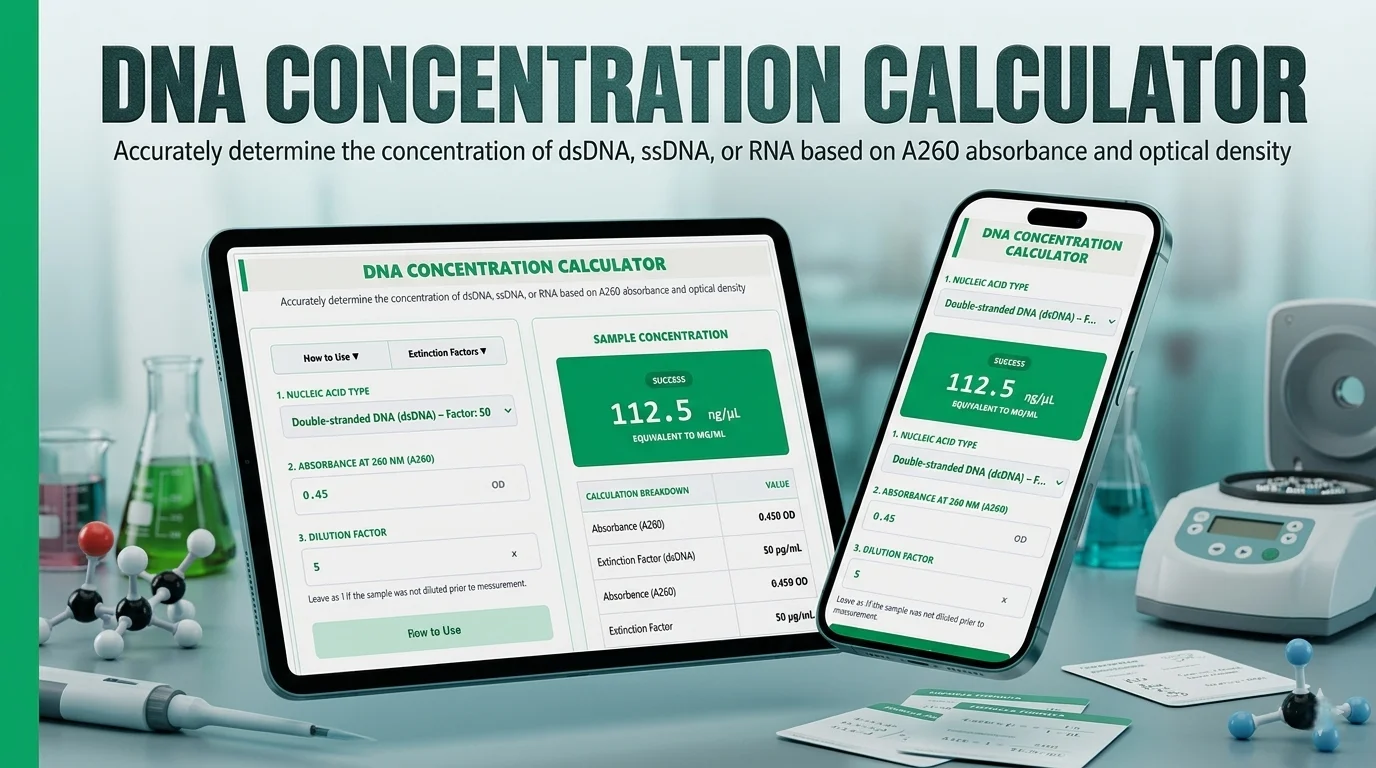
The relationship between absorbance and concentration is linear, governed by the Beer-Lambert Law. A ph concentration calculator utilizes specific extinction coefficients (conversion factors) based on the molecular structure of the nucleic acid. The standard formula is:
Concentration = A260 × Extinction Factor × Dilution FactorStandard Extinction Factors (per 1 OD unit at a 1 cm pathlength):
- Double-stranded DNA (dsDNA): 50 µg/mL
- Single-stranded DNA (ssDNA): 33 µg/mL
- RNA: 40 µg/mL
How to Calculate pH Concentration (Step-by-Step)
- Blank the Spectrophotometer: Use the exact buffer your DNA is suspended in (e.g., nuclease-free water or TE buffer) to set a baseline of zero absorbance.
- Measure the Sample: Pipette your sample onto the pedestal (or into a cuvette) and read the optical density (OD) at 260 nm.
- Determine the Dilution Factor: If you mixed 1 µL of DNA into 9 µL of water to take the reading, your total volume is 10, meaning your dilution factor is 10. (If undiluted, the factor is 1).
- Apply the Formula: Multiply the A260 reading by the appropriate extinction factor (e.g., 50 for dsDNA) and then by your dilution factor.
pH Concentration Using A260 Method
The A260 method is the industry standard for UV spectrophotometry. Nucleic acids strongly absorb ultraviolet light specifically at a wavelength of 260 nanometers (nm). This characteristic absorption peak is caused by the heterocyclic rings of the purine and pyrimidine bases (Adenine, Thymine, Cytosine, Guanine, and Uracil). By measuring how much light passes through the sample versus how much is absorbed, machines like a NanoDrop can instantly output the OD260.
pH Concentration Units (ng/µL, µg/mL Explained)
Researchers frequently see ph concentration reported in either ng/µL (nanograms per microliter) or µg/mL (micrograms per milliliter). In laboratory math, these two units are numerically identical. Because both the mass (micrograms to nanograms) and the volume (milliliters to microliters) decrease by a factor of 1,000, the ratio remains exactly the same. Most bench scientists prefer ng/µL because it aligns perfectly with the micro-volumes used in pipettes.
Example Calculation of pH Concentration
Let’s say you have extracted genomic DNA (dsDNA) and diluted it by adding 2 µL of sample into 98 µL of TE buffer (a 50x dilution factor). Your cuvette spectrophotometer provides an A260 reading of 0.150 OD.
- A260 Reading: 0.150
- Factor for dsDNA: 50
- Dilution Factor: 50
Calculation: 0.150 × 50 × 50 = 375 ng/µL. The original stock concentration is 375 ng/µL.
DNA Molarity vs Concentration – Key Differences
While standard concentration (ng/µL) measures the total mass of DNA in a volume, DNA molarity measures the number of molecules (moles) in a volume. Molarity is essential for reactions that rely on molecular ratios, such as ligations. To convert mass concentration to molarity, you must know the exact length of the DNA sequence (in base pairs) to determine its molecular weight.
Factors Affecting pH Concentration Accuracy
- Contamination: Co-extracted RNA, proteins, or residual phenol from RNA extraction protocols will artificially inflate the A260 reading, leading to an overestimation of DNA.
- Improper Blanking: Failing to blank the instrument with the exact elution buffer used for the sample throws off baseline optical density.
- Sample Homogenization: Genomic DNA can be highly viscous. If the sample is not well-mixed, you may pipette a highly concentrated clump, giving a false reading.
Common Methods to Measure pH Concentration
There are two primary methods used in modern labs:
- UV Spectrophotometry (e.g., NanoDrop): Fast, requires no reagents, and provides purity ratios (A260/A280). However, it cannot distinguish between DNA, RNA, or free nucleotides.
- Fluorometric Quantification (e.g., Qubit): Uses fluorescent dyes that bind specifically to dsDNA, ssDNA, or RNA. This method is highly sensitive and much more accurate for low-concentration samples or highly degraded genetic material.
pH Concentration Conversion (ng/µL to µg/mL)
As mentioned earlier, converting between ng/µL and µg/mL requires no complex math—the values are identical. 1 ng/µL = 1 µg/mL.
If your ph concentration calculator outputs 45 ng/µL, you can confidently write 45 µg/mL in your lab notebook if required by a specific protocol.
Applications of pH Concentration in Lab Experiments
Precise quantification is mandatory for:
- Polymerase Chain Reaction (PCR): Ensuring proper template-to-primer ratios.
- Next-Generation Sequencing (NGS): Library preparation requires strictly normalized input amounts to prevent flow cell overloading.
- Transfection: Introducing plasmids into mammalian cells requires an optimal mass of DNA to prevent cellular toxicity while ensuring high expression.
Common Mistakes in pH Concentration Calculation
The most frequent errors bench scientists make include forgetting to multiply by the dilution factor when using standard cuvettes, or using the wrong extinction coefficient (e.g., multiplying an RNA sample by 50 instead of 40). Additionally, trusting an A260 reading blindly without checking the A260/A280 purity ratio can lead to using severely contaminated DNA in sensitive assays.