Percentage Increase Calculator
What is a Percentage Increase Calculator?
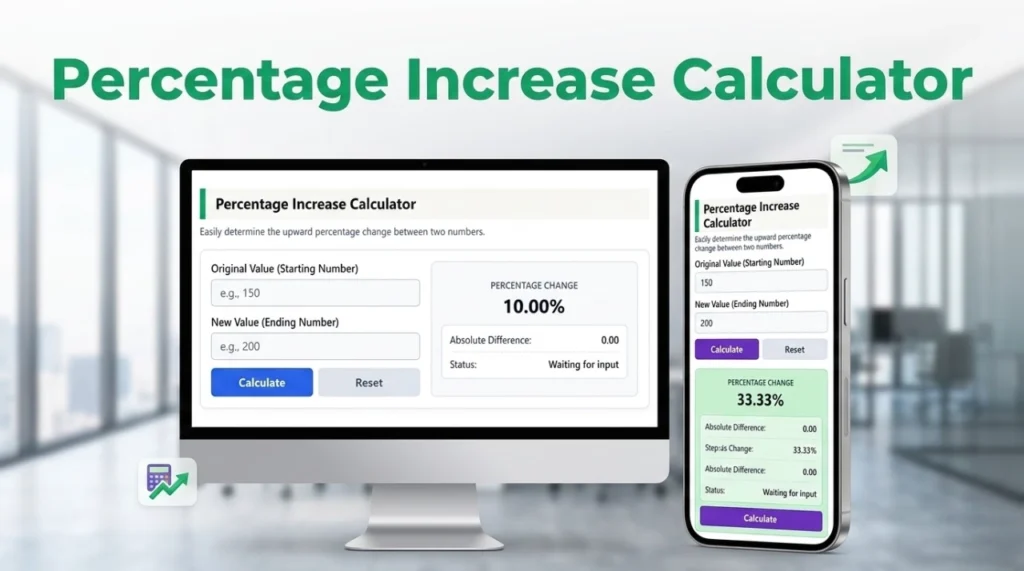
A percentage increase calculator is a simple tool that helps you figure out exactly how much a number has grown. Whenever a price goes up, a salary increases, or a score gets higher, this calculator tells you the exact percentage of that growth.
Instead of doing complicated math in your head or trying to remember old school formulas, a percentage increase calculator does all the hard work for you instantly. All you have to do is type in your starting number and your new, higher number.
Quick Reference: Common Percentage Increases
To help you understand how growth looks in real life, here is a quick table showing some common examples of price increases and their matching percentages:
| Original Number | New Number | Amount it Grew By | Percentage Increase |
|---|---|---|---|
| $100 | $110 | $10 | 10% |
| $50 | $60 | $10 | 20% |
| $200 | $250 | $50 | 25% |
| $80 | $120 | $40 | 50% |
| $100 | $200 | $100 | 100% (It doubled) |
How to Calculate a Percentage Increase Yourself
Our percentage increase calculator makes finding the answer easy, but it is also good to know how the math works behind the scenes. Here is the simple formula:
Let’s try a real-life example: Imagine your monthly grocery bill went from $200 to $250.
- First, find out how much extra you are paying: $250 − $200 = $50.
- Next, divide that $50 difference by your original $200 bill: $50 / $200 = 0.25.
- Finally, multiply by 100 to turn it into a percentage: 0.25 × 100 = 25% Increase.
When to Use Different Percentage Calculators
While a percentage increase calculator is perfect for tracking growth, sometimes you need to solve a different kind of math problem. Luckily, we have easy tools for every situation!
If you are tracking a number that is going down—like a dropping stock price or an item on sale—you will want to switch over to our percentage decrease calculator.
If you just want to compare two different numbers (like the population of two towns) without worrying about which one came first, the easiest tool to use is our percentage difference calculator.
For high school or college students trying to figure out their final grades across multiple classes, a standard calculator won’t help much. For that, use our dedicated aggregate percentage calculator to combine your scores easily.
And finally, if you just need to do basic everyday math—like figuring out a 20% tip at a restaurant—our standard percentage calculator is always ready to help.
Frequently Asked Questions (FAQ)
How do I calculate a percentage increase?
To calculate a percentage increase, subtract your original number from your new number. Take that difference, divide it by the original number, and multiply the result by 100.
What happens if the new value is less than the original value?
If the new value is lower, the result will be a negative percentage. This represents a “percentage decrease.” Our calculator automatically detects this and will display the result in red as a decrease.
Can a percentage increase be greater than 100%?
Yes! A 100% increase means the value has doubled. A 200% increase means the value has tripled. There is no mathematical limit to how high a percentage increase can go.
Why do we divide by the “absolute” original value?
Using the absolute value (ignoring negative signs) of the original number ensures that the math remains accurate and points in the right direction if your starting number happens to be negative.
Can the original value be zero?
No, you cannot mathematically divide by zero. If you start with 0 and end with a larger number, the percentage increase is technically undefined (or infinite).