Percentage Decrease Calculator
What is a Percentage Decrease Calculator?
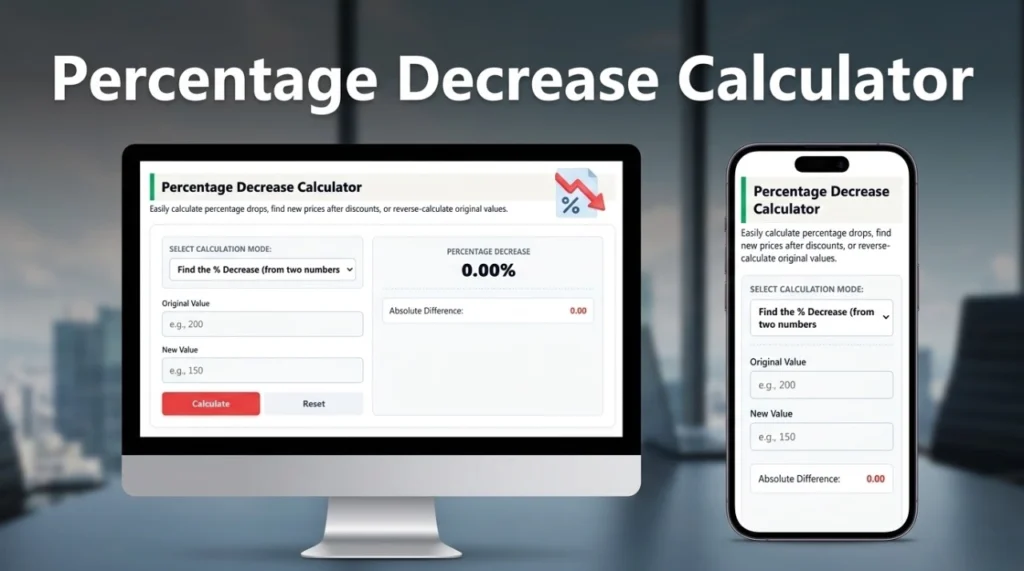
A percentage decrease calculator is a fast, easy-to-use tool designed to show you exactly how much a number has gone down. Whether you are trying to figure out how much cash you’ll save during a holiday sale, tracking how much weight you’ve lost, or analyzing a drop in website traffic, this tool handles the complicated math for you instantly.
Instead of wrestling with formulas or decimals on scratch paper, you just need to enter your starting number and your ending number. The percentage decrease calculator will immediately tell you the exact percentage drop, along with the absolute difference between the two numbers.
Quick Reference: Common Percentage Decreases
If you don’t have the calculator handy, it’s helpful to know what standard discounts and drops look like. Use this simple table to see how common starting numbers change when reduced by 10%, 25%, and 50%.
| Original Amount | Reduced by 10% | Reduced by 25% | Reduced by 50% (Half) |
|---|---|---|---|
| 50 | 45 | 37.5 | 25 |
| 100 | 90 | 75 | 50 |
| 200 | 180 | 150 | 100 |
| 500 | 450 | 375 | 250 |
| 1000 | 900 | 750 | 500 |
How to Calculate a Percentage Decrease Manually
Our interactive percentage decrease calculator features three different modes to solve any math problem you encounter. Here is the logic and formulas it uses behind the scenes:
1. Finding the % Drop Between Two Numbers:
If you know a stock price fell from $80 to $60, you find the difference ($20). You then divide that difference by the original price (20 / 80 = 0.25) and multiply by 100. The result is a 25% decrease.
2. Finding a Final Price After a Discount:
If you want to buy a $120 jacket that is 30% off, you convert the percentage to a decimal (0.30) and multiply it by the price to find your savings ($120 × 0.30 = $36). Subtract the savings from the original price ($120 − $36) to find your new price of $84.
3. Reverse-Engineering an Original Price:
If you bought a TV for $300 on a 40% clearance sale, what was the original price? First, subtract the discount from 100% (100% − 40% = 60%, or 0.60). Then divide what you paid by that decimal ($300 / 0.60). The original price was $500.
Choosing the Right Percentage Calculator
Depending on the specific numbers you are crunching, a standard percentage decrease calculator might not be the right fit. If your numbers are actually going up (like a rent hike or a raise at work), you will want to jump over to our Percentage Increase Calculator.
Sometimes, you just need to find the gap between two completely unrelated numbers, like comparing the height of two different buildings. Because neither building “decreased” into the other, you should use our Percentage Difference Calculator for the most accurate mathematical comparison.
If you are a student or a teacher trying to combine several quiz and exam scores into one final grade, standard decrease formulas won’t give you the right answer. Instead, rely on our Aggregate Percentage Calculator.
Finally, for everyday math—like figuring out a quick 18% restaurant tip or finding out what a fraction of a whole is—our standard Percentage Calculator is the perfect tool for the job.
FaQs
1. How to calculate percentage of decrease?
To calculate the percentage decrease, subtract the new value from the original value, divide the result by the original value, and multiply by 100.
Formula:
\(\text{Percentage Decrease} = \frac{\text{Original Value – New Value}}{\text{Original Value}} \times 100\)
2. How to calculate a 75% reduction?
A 75% reduction means subtracting 75% of the original value.
Steps:
Convert 75% to decimal → 0.75
Multiply by the original value
Subtract the result from the original value
Example: If the original value is 200 →
75% of 200 = 150 →
200 − 150 = 50.
3. How to find a 20% decrease?
Multiply the original value by 0.20 to find the decrease amount, then subtract it from the original value.
Example:
Original value = 100
20% of 100 = 20
New value = 80.
4. What is a Percentage Decrease Calculator?
A Percentage Decrease Calculator is a tool that calculates how much a value has decreased compared to its original value, expressed as a percentage.
5. How do you calculate the new value after a percentage decrease?
Subtract the decrease amount from the original value.
Formula:
6. What is the difference between percentage decrease and percentage change?
Percentage decrease only measures a drop in value, while percentage change can represent both increase and decrease.