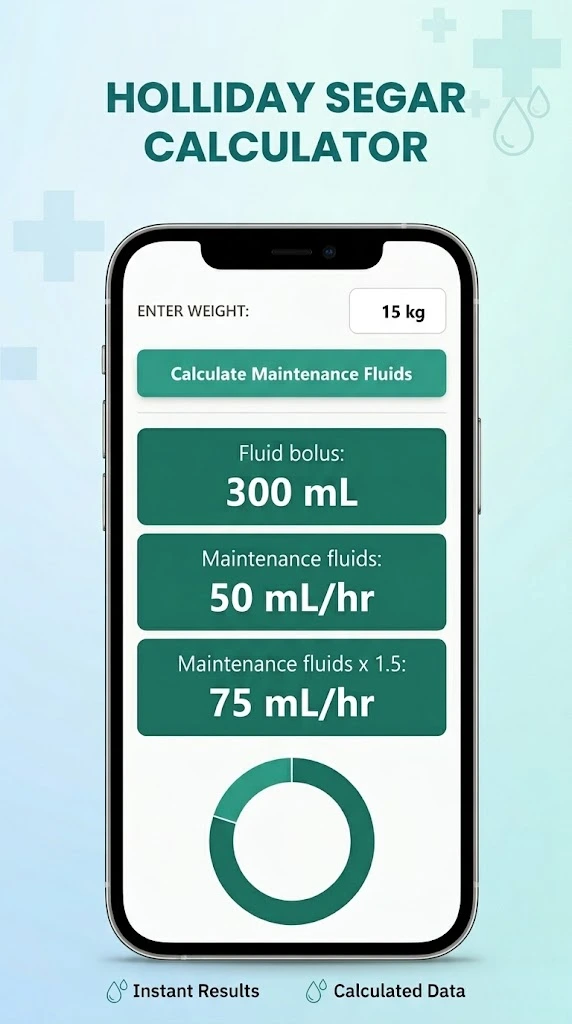
HOLLIDAY SEGAR CALCULATOR
- Determining IV fluid rates for patients not taking oral fluids (e.g., NPO for surgery).
- Determining IV fluid requirements for patients who are dehydrated or have ongoing losses.
Weight-based dosing of fluids is important given the fact that a patient’s total body water (and blood volume) are strictly based on their weight.
Formula (4-2-1 Rule)
- For 0-10 kg: 4 mL/kg/hr
- For >10-20 kg: 40 mL + 2 mL/kg/hr for every kg >10
- For >20 kg: 60 mL + 1 mL/kg/hr for every kg >20
Creator Insights
Malcolm Holliday, MD, (d. 2014) was a pediatric nephrologist and physiologist. His original work studying inherited tubular disorders and congenital renal defects led him to develop standard hydration practices.
Understanding the Holliday Segar Calculator & The 4-2-1 Rule
Calculating accurate intravenous (IV) fluid rates is a fundamental skill in pediatric medicine. Because children have a higher percentage of total body water and different metabolic rates compared to adults, weight-based fluid dosing is critical to prevent severe complications such as dehydration or fluid overload. For safe and precise PEDIATRIC FLUID calculation, healthcare providers rely on established clinical guidelines, utilizing a pediatric fluid calculator to ensure accuracy.
What is the Holliday Segar Method?
The holliday segar method, also widely known as the 4-2-1 rule, is the universally accepted standard for maintenance fluid calculation in pediatric and adult patients. Originally derived in 1957, this baseline approach estimates caloric expenditure and the corresponding water requirements necessary to maintain physiological homeostasis. It serves as an essential child fluid requirement calculator algorithm.
By utilizing the holliday segar equation, clinicians can break down the patient’s weight into three distinct tiers to find the exact hourly rate:
- First 10 kg of body weight: 4 mL/kg/hr (or 100 mL/kg/day)
- Second 10 kg (11 to 20 kg): +2 mL/kg/hr (or 50 mL/kg/day)
- Every kilogram above 20 kg: +1 mL/kg/hr (or 20 mL/kg/day)
Example Calculation
Let’s look at how the holliday segar formula works in practice for a child weighing 25 kg:
| Weight Tier | Calculation | Result (mL/hr) |
|---|---|---|
| First 10 kg | 10 kg × 4 mL/kg/hr | 40 mL/hr |
| Next 10 kg (11-20 kg) | 10 kg × 2 mL/kg/hr | 20 mL/hr |
| Remaining 5 kg (>20 kg) | 5 kg × 1 mL/kg/hr | 5 mL/hr |
| Total Maintenance Rate | 65 mL/hr | |
When to Use Maintenance Fluids
Maintenance fluids derived from the holliday segar formula are indicated when a patient cannot meet their daily water and electrolyte needs via enteral intake (by mouth or feeding tube). Common clinical scenarios include:
- NPO Status: Patients fasting prior to or immediately following surgery.
- Gastrointestinal Illness: Severe gastroenteritis, intractable vomiting, or conditions preventing safe swallowing.
- Respiratory Distress: Conditions like severe bronchiolitis where oral feeding poses an aspiration risk.
Calculating Fluid Bolus for Resuscitation
While maintenance fluids replace ongoing daily losses, a fluid bolus is used for rapid volume expansion in hemodynamically unstable or severely dehydrated patients. The standard pediatric fluid bolus is 20 mL/kg of an isotonic crystalloid (such as 0.9% Normal Saline or Lactated Ringer’s), typically administered over 5 to 20 minutes depending on the severity of shock.
Important Considerations
While this tool provides an excellent baseline, clinicians must adjust fluid rates based on the individual patient. Key limits and cautions include:
- Max Limits: As a general guide, males rarely need over 2.5 liters, and females rarely need over 2 liters per 24 hours.
- Application: Primarily for pediatric patients, though sometimes applied to adults.
- Caution: Use with care in patients with renal failure, heart failure, or severe burns.
- Obesity: In overweight or obese adolescents, using actual body weight can lead to dangerous fluid overload. Clinicians should generally use Ideal Body Weight (IBW) when calculating maintenance fluids for obese patients.
Evidence and Sources
The core principles powering this calculator are rooted in the landmark clinical research paper published by Malcolm Holliday and William Segar (Pediatrics. 1957;19(5):823-832). Their physiological validation of water needs tied to caloric expenditure remains the gold standard in pediatric fluid therapy worldwide.
FAQs
What is the Holliday-Segar formula?
The Holliday-Segar formula is used to calculate daily maintenance fluid requirements in children based on body weight. It is widely used in pediatrics.
What is maintenance fluid in children?
Maintenance fluid refers to the amount of fluid required daily to maintain normal body functions like hydration, metabolism, and circulation.
When is the Holliday-Segar method used?
It is used in hospitals and clinical settings to calculate IV fluids and daily fluid needs for infants and children.
8. What is the 4-2-1 rule in pediatric fluids?
The 4-2-1 rule is used to calculate hourly fluid rate:
4 mL/kg for first 10 kg
2 mL/kg for next 10 kg
1 mL/kg for remaining weight
Why is fluid calculation important in pediatrics?
Proper fluid calculation helps prevent dehydration, overhydration, and complications, ensuring safe and effective treatment.