HEART RATE RESERVE (HRR) CALCULATOR
- Determining your true cardiovascular capacity for exercise.
- Calculating personalized target heart rate zones using the Karvonen method.
Standard heart rate formulas only consider your age. HRR factors in your Resting Heart Rate (a key indicator of fitness), providing a much more accurate and individualized training metric.
HRR (BPM)
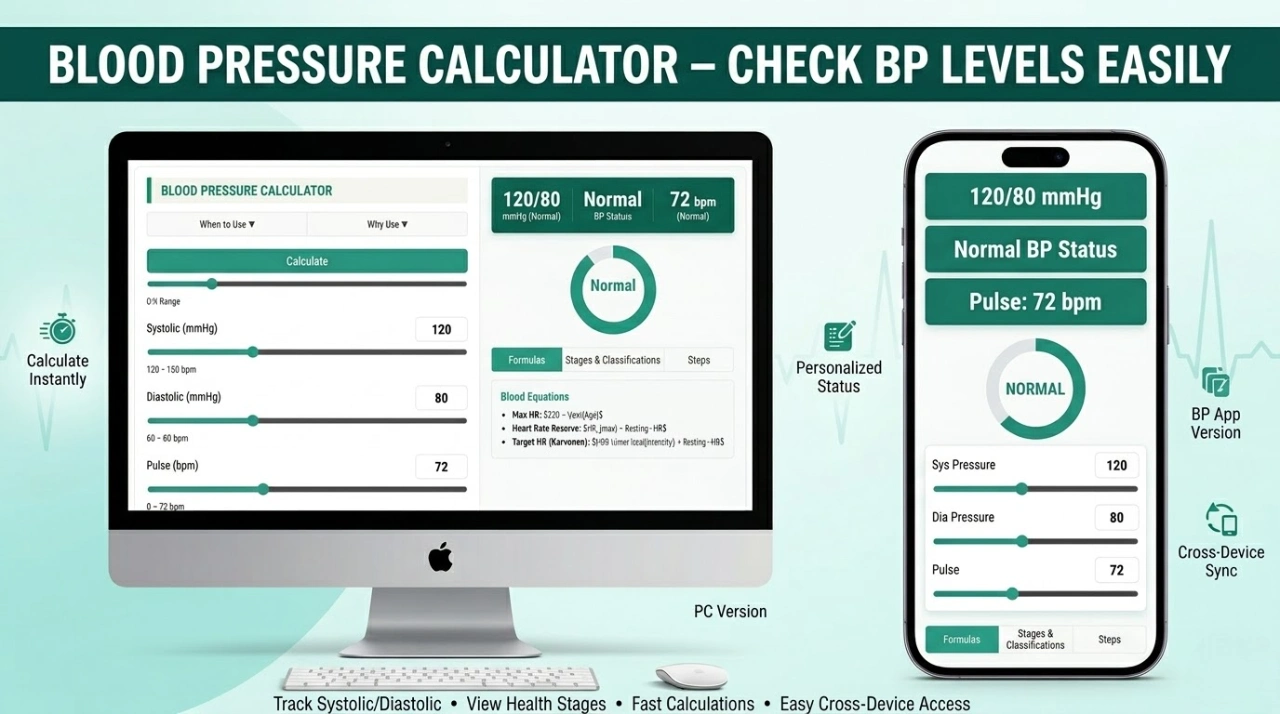
HRR Equations
- Max HR: $220 – \text{Age}$
- Heart Rate Reserve: $HR_{max} – Resting~HR$
- Target HR (Karvonen): $(HRR \times \text{Intensity}) + Resting~HR$
Understanding Your HRR
Your HRR represents your heart’s functional capacity to increase its beating rate above its resting level. A higher HRR generally indicates a stronger, more efficient cardiovascular system (common in athletes).
Understanding the Heart Rate Reserve (HRR) Calculator
When designing a cardiovascular fitness program or monitoring a patient in cardiac rehabilitation, precision is key. The traditional method of calculating exercise intensity relies solely on a person’s age. However, this ignores a massive variable: a person’s baseline fitness level. This is where calculating your Heart Rate Reserve (HRR) becomes essential.
What is Heart Rate Reserve (HRR)?
Heart Rate Reserve is the difference between your Maximum Heart Rate ($HR_{max}$) and your Resting Heart Rate ($HR_{rest}$). Essentially, it represents your heart’s functional “cushion” or capacity to increase its beating rate during physical exertion.
Athletes and highly fit individuals typically have lower resting heart rates. Because their resting rate is lower, their Heart Rate Reserve is larger, meaning they have a wider range of cardiovascular capacity to utilize during a workout compared to a sedentary person of the exact same age.
How to Calculate Your HRR
Calculating your HRR requires two data points: your age and your resting heart rate. The widely accepted clinical formula is:
Heart Rate Reserve Equation: $$HRR = HR_{max} – HR_{rest}$$
(Where $HR_{max}$ is typically estimated as $220 – \text{Age}$)
Example HRR Calculation
Let’s calculate the HRR for a 40-year-old with a resting heart rate of 65 bpm:
- Find Max HR: $220 – 40 = 180 \text{ bpm}$
- Subtract Resting HR: $180 – 65 = 115 \text{ bpm}$
This individual’s Heart Rate Reserve is 115 bpm.
Using HRR for Target Training (The Karvonen Method)
The primary reason clinicians and fitness coaches calculate HRR is to use it within the Karvonen Formula. This formula dictates that to find a highly accurate target heart rate for a specific intensity zone, you multiply the intensity percentage by the HRR, and then add the resting heart rate back in.
Target Heart Rate (Karvonen): $$\text{Target HR} = (HRR \times \text{Intensity \%}) + HR_{rest}$$
Using the example above for a 40-year-old wanting to train at a 70% aerobic intensity:
- $115 \text{ (HRR)} \times 0.70 = 80.5$
- $80.5 + 65 \text{ (Resting HR)} = 145.5 \text{ bpm}$
Why Measure Resting Heart Rate Properly?
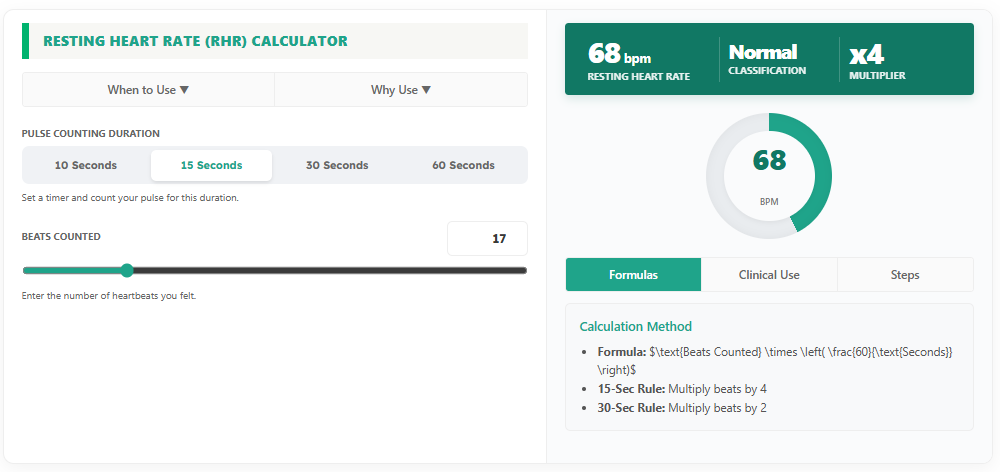
Because the HRR formula relies heavily on your Resting Heart Rate, an inaccurate measurement will ruin your training zones. A normal resting rate is between 60 and 100 bpm. To get your true baseline, measure your pulse for a full 60 seconds immediately after waking up in the morning, while still lying in bed, before consuming any caffeine or experiencing physical stress.
Evidence and References
- Heart Rate Reserve and Target Heart Rate Methodologies – NIH
- Cardiovascular Adaptations to Exercise – StatPearls