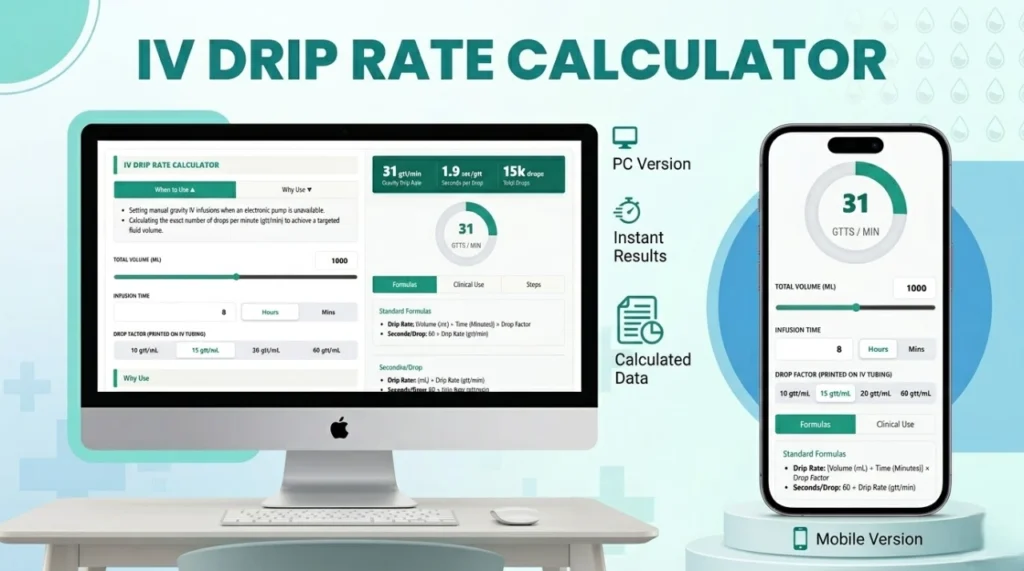
IV DRIP RATE CALCULATOR
- Setting manual gravity IV infusions when an electronic pump is unavailable.
- Calculating the exact number of drops per minute (gtt/min) to achieve a targeted fluid volume.
Counting the correct seconds per drop prevents dangerous fluid overload or under-dosing, especially in sensitive patients or pediatric care.
drops / min
Standard Formulas
- Drip Rate: [Volume (mL) ÷ Time (Minutes)] × Drop Factor
- Seconds/Drop: 60 ÷ Drip Rate (gtt/min)
Clinical Context
For manual gravity infusions, you cannot count half a drop. The final `gtt/min` must always be rounded to the nearest whole number. Use the “Seconds per Drop” metric to calibrate the roller clamp.
How to Use an IV Drip Rate Calculator
In clinical environments where electronic infusion pumps are unavailable, nurses and medical professionals must manually regulate intravenous (IV) fluids using gravity. An IV Drip Rate Calculator is an essential tool that computes exactly how many drops must fall into the drip chamber each minute to safely deliver the prescribed medication or hydration.
Understanding the Drop Factor
To calculate a manual gravity drip, you must know the Drop Factor of the IV tubing being used. The drop factor is the calibration of the IV tubing—specifically, how many drops (gtt) it takes to equal 1 milliliter (mL) of fluid. This number is always prominently printed on the tubing’s packaging.
Macrodrip vs. Microdrip Tubing sets
- Macrodrip Tubing (10, 15, or 20 gtt/mL): These sets have wider openings and deliver large drops. They are standard for rapid fluid resuscitation, adult hydration, and routine IV antibiotics.
- Microdrip Tubing (60 gtt/mL): These sets feature a tiny needle inside the drip chamber, creating very small drops. They are heavily utilized in pediatric care, for sensitive medication titrations (like vasopressors), and for patients requiring strict fluid restriction.
Standard Drip Rate Formulas
A reliable IV drip rate calculator relies on universal clinical equations to determine the flow of fluids. The primary formula used to find drops per minute (gtt/min) is:
Drip Rate (gtt/min):
Total Volume (mL) Total Time (minutes) × Drop Factor (gtt/mL) = gtt/min
Because humans cannot visually count partial drops, the final clinical result must always be rounded to the nearest whole number.
Example Gravity Drip Calculation
Scenario: A physician orders 500 mL of Lactated Ringer’s to be infused manually over 4 hours. The nurse selects Macrodrip tubing with a drop factor of 20 gtt/mL.
| Metric | Calculation Step | Result |
|---|---|---|
| Convert Time | 4 Hours × 60 Minutes | 240 Minutes |
| Find mL per Minute | 500 mL ÷ 240 Minutes | 2.08 mL/min |
| Apply Drop Factor | 2.08 mL/min × 20 gtt/mL | 41.6 Drops/min |
| Final Drip Rate | Round 41.6 to nearest whole number | 42 gtt/min |
Counting Seconds Per Drop
Once the `gtt/min` is calculated, setting the roller clamp can still be challenging. To make manual calibration easier, nurses often calculate the Seconds per Drop.
Seconds per Drop:
60 Seconds Drip Rate (gtt/min) = Seconds per drop
Using the example above (42 gtt/min): 60 ÷ 42 = 1.4 seconds. The nurse would adjust the roller clamp until they see one drop fall approximately every 1.5 seconds.
Important Clinical Considerations
When utilizing an IV Drip Rate Calculator, remember that gravity drips are highly sensitive to physical changes:
- Patient Position: Bending the arm or moving can crimp the catheter and drastically slow the drip rate.
- Height of the IV Bag: Elevating the IV pole increases gravitational pressure and speeds up the drip rate; lowering it slows the rate.
- Viscosity: Thicker fluids (like blood products) run slower than clear crystalloids. Always monitor the drip chamber frequently and readjust the roller clamp as needed.
Evidence and References
- Medical Math & Clinical Calculations – StatPearls – NCBI Bookshelf
- Intravenous Fluid Therapy – StatPearls – NCBI Bookshelf
FAQs
What is an IV drip rate calculator?
An IV drip rate calculator is a tool used to calculate the number of drops per minute (gtt/min) needed to deliver fluids accurately.
How do you calculate IV drip rate?
IV drip rate is calculated using the formula:
(Volume × Drop Factor) ÷ Time (in minutes) to get drops per minute.
What does gtt/min mean?
gtt/min means drops per minute. It is the unit used to measure how fast IV fluid is delivered manually.
What is drop factor in IV drip calculation?
Drop factor is the number of drops per milliliter (gtt/mL) delivered by the IV set, such as 10, 15, 20, or 60 gtt/mL.
Can I convert mL/hr to gtt/min?
Yes, you can convert mL/hr to gtt/min using drop factor and time. This calculator helps you do it instantly.