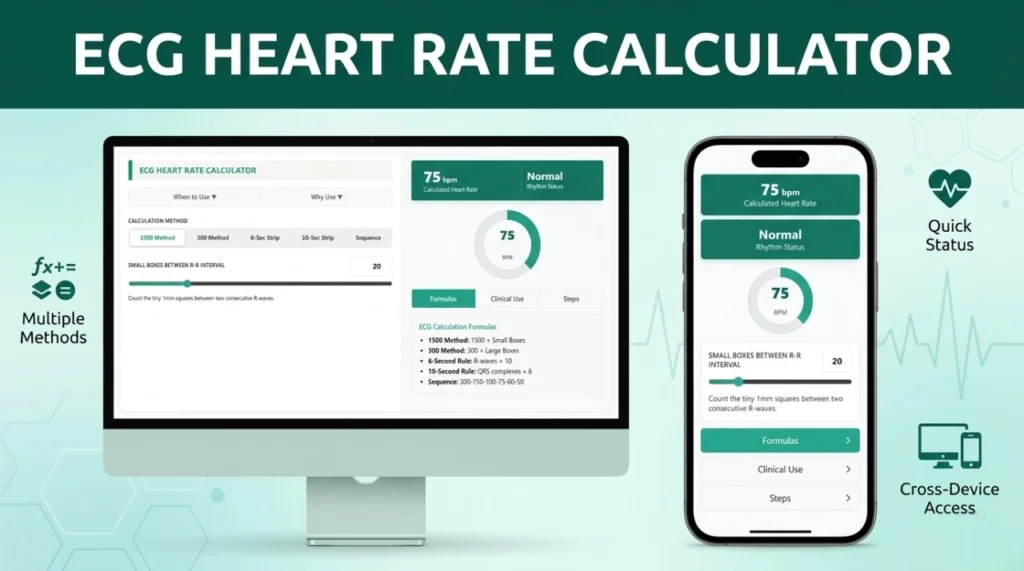
ECG HEART RATE CALCULATOR
- Calculating heart rate directly from an electrocardiogram (ECG/EKG) paper strip.
- Assessing bradycardia, tachycardia, or normal sinus rhythm manually.
Manual calculation is essential when machine readouts are unreliable, or when assessing irregular rhythms (like Atrial Fibrillation) where automated monitors often fail.
BPM
ECG Calculation Formulas
- 1500 Method: 1500 ÷ Small Boxes
- 300 Method: 300 ÷ Large Boxes
- 6-Second Rule: R-waves × 10
- 10-Second Rule: QRS complexes × 6
- Sequence: 300-150-100-75-60-50
Clinical Context
The 1500 method is the most precise for regular rhythms. The 300 & Sequence methods provide rapid estimations. The 6-sec and 10-sec rules are the only mathematically valid manual methods for calculating irregular rhythms like Atrial Fibrillation.
Understanding the ECG Heart Rate Calculator
An electrocardiogram (ECG or EKG) is a vital diagnostic tool used to measure the electrical activity of the heart. While modern cardiac monitors provide digital readouts of a patient’s heart rate, healthcare providers must know how to manually calculate beats per minute (BPM) directly from the ECG paper strip. This ensures accuracy when machines fail, face interference, or misread complex arrhythmias.
Standard ECG paper runs at a speed of 25 mm per second. Because the speed is constant, the grid boxes printed on the paper represent specific increments of time. Our ECG Heart Rate Calculator utilizes the primary universally accepted clinical methods to convert these boxes into an accurate BPM.
Common ECG Heart Rate Methods
1500 Method (Small Square Method) (Precise/Fast Rhythms)
Count the number of small (1mm) squares between R-waves and divide 1500 by this number. Every tiny 1mm square on the ECG paper represents 0.04 seconds, and there are exactly 1500 small boxes in one minute.
Example: 20 small squares = 1500 ÷ 20 = 75 bpm.
300 Method (Big Square Method) (Regular Rhythms)
Count the number of large (5mm) squares between two consecutive R-waves (R-R interval) and divide 300 by this number. Every heavy-lined large box represents 0.20 seconds, meaning there are 300 large boxes in one minute.
Example: 4 large squares = 300 ÷ 4 = 75 bpm.
Sequence Method (300-150-100-75-60-50)
This is a rapid visual estimation tool derived directly from the 300 method. Find an R-wave that lands exactly on a bold line, then name subsequent bold lines 300, 150, 100, 75, 60, 50, based on where the next R-wave falls.
6-Second Method (Irregular Rhythms)
If a patient has an irregular rhythm (such as Atrial Fibrillation), the distance between R-waves constantly changes, making the previous methods invalid. Count the number of R-waves (QRS complexes) on a 6-second strip (30 large boxes) and multiply by 10.
10-Second Method (Standard ECGs)
Similar to the 6-second rule, this is highly effective for irregular rhythms and is incredibly convenient because most standard 12-lead printouts are exactly 10 seconds long. Count the QRS complexes on a full 10-second strip and multiply by 6.
Rhythm Classifications
Once you calculate the BPM, the heart rate falls into one of three primary clinical categories for an adult at rest:
| Classification | Heart Rate (BPM) | Clinical Notes |
|---|---|---|
| Bradycardia | < 60 BPM | Can be normal in athletes; may indicate block or ischemia in others. |
| Normal Sinus Rhythm | 60 – 100 BPM | The standard resting heart rate for healthy adults. |
| Tachycardia | > 100 BPM | Indicates a rapid heart rate. Can be caused by fever, stress, dehydration, or arrhythmias. |
Evidence and References