TANAKA HEART RATE CALCULATOR
- Estimating a highly accurate Maximum Heart Rate ($HR_{max}$) for adults, especially those over 40.
- Setting precise intensity targets for cardiovascular training or clinical testing.
The traditional 220-age formula significantly underestimates max heart rate in older adults. The Tanaka equation corrects this bias, providing a safer and more effective baseline for exercise prescription.
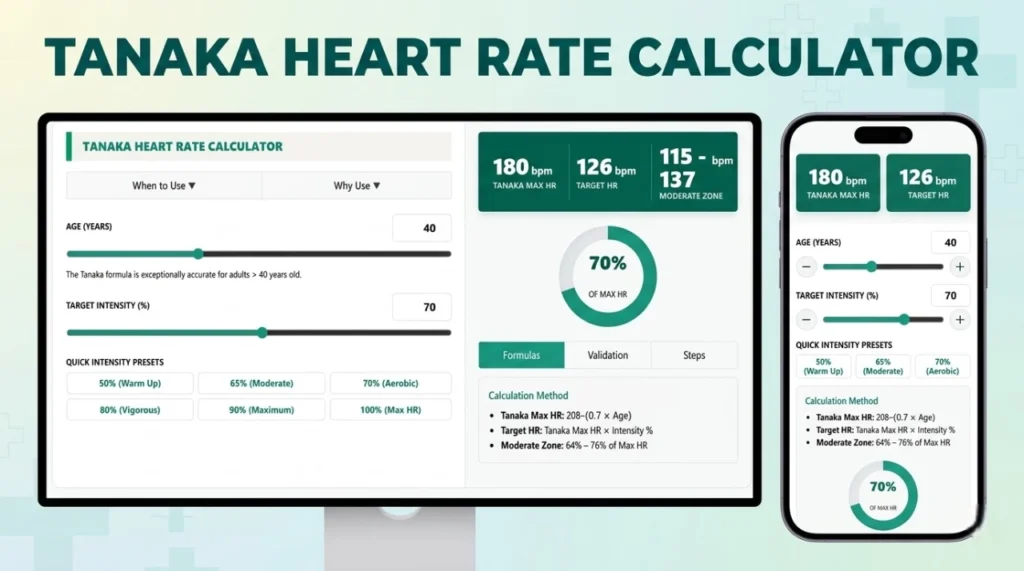
of Max HR
Calculation Method
- Tanaka Max HR: $208 – (0.7 \times \text{Age})$
- Target HR: Tanaka Max HR $\times$ Intensity %
- Moderate Zone: 64% – 76% of Max HR
Clinical Accuracy
Developed by Dr. Hirofumi Tanaka in 2001, this regression equation was created after analyzing data from over 18,000 subjects. It is widely endorsed by the American College of Sports Medicine (ACSM) as a superior alternative to the 220-age formula.
Understanding the Tanaka Heart Rate Formula
For decades, fitness professionals and clinicians relied on the traditional “220 minus age” formula to estimate a patient’s maximum heart rate. However, recent physiological studies have proven that this legacy equation is fundamentally flawed—specifically because it heavily underestimates cardiovascular capacity in older adults. The Tanaka heart rate formula is a modern, generally more accurate method for estimating maximum heart rate ($HR_{max}$), particularly for individuals over 40.
How to Calculate Tanaka Max Heart Rate
Developed in 2001 by Dr. Hirofumi Tanaka, this regression equation was validated against thousands of laboratory tests. This formula helps determine exact training zones for exercise intensity safely and accurately.
It is calculated as:
$$HR_{max} = 208 – (0.7 \times \text{Age})$$To calculate your Tanaka Max Heart Rate manually:
- Multiply your exact age by 0.7.
- Subtract that resulting number from 208.
Example for a 40-year-old: $$0.7 \times 40 = 28$$ $$208 – 28 = 180 \text{ bpm (Beats per minute)}$$
Target Heart Rate Zones (Approximate)
Once you have successfully calculated your Tanaka Max Heart Rate ($HR_{max}$), you can define specific training intensities to meet your metabolic goals:
- Moderate Intensity (Zone 2/3): 64% – 76% of $HR_{max}$. This zone is highly recommended for building base endurance and steady fat oxidation.
- Vigorous Intensity (Zone 4/5): 77% – 95% of $HR_{max}$. This zone pushes anaerobic threshold, increases lung capacity, and is utilized in high-intensity interval training (HIIT).
Why Use Tanaka?
- Accuracy: It provides a significantly better physiological estimate than the old $220 – \text{Age}$ formula, which often limits performance by underestimating $HR_{max}$ in older adults.
- Validation: Study results published by the American College of Sports Medicine indicate that the formula $HR_{max} = 208 – (0.7 \times \text{Age})$ has minimal bias in estimating $HR_{max}$ during maximal exertion treadmill tests.
- Applicability: It was specifically designed to be robust across entirely different age groups and baseline fitness levels, whether the subject is sedentary or an endurance athlete.
Evidence and References
- Age-predicted maximal heart rate revisited – PubMed (NIH)
- Exercise intensity: How to measure it – Mayo Clinic