RESTING HEART RATE (RHR) CALCULATOR
- Determining your baseline cardiovascular health and fitness level.
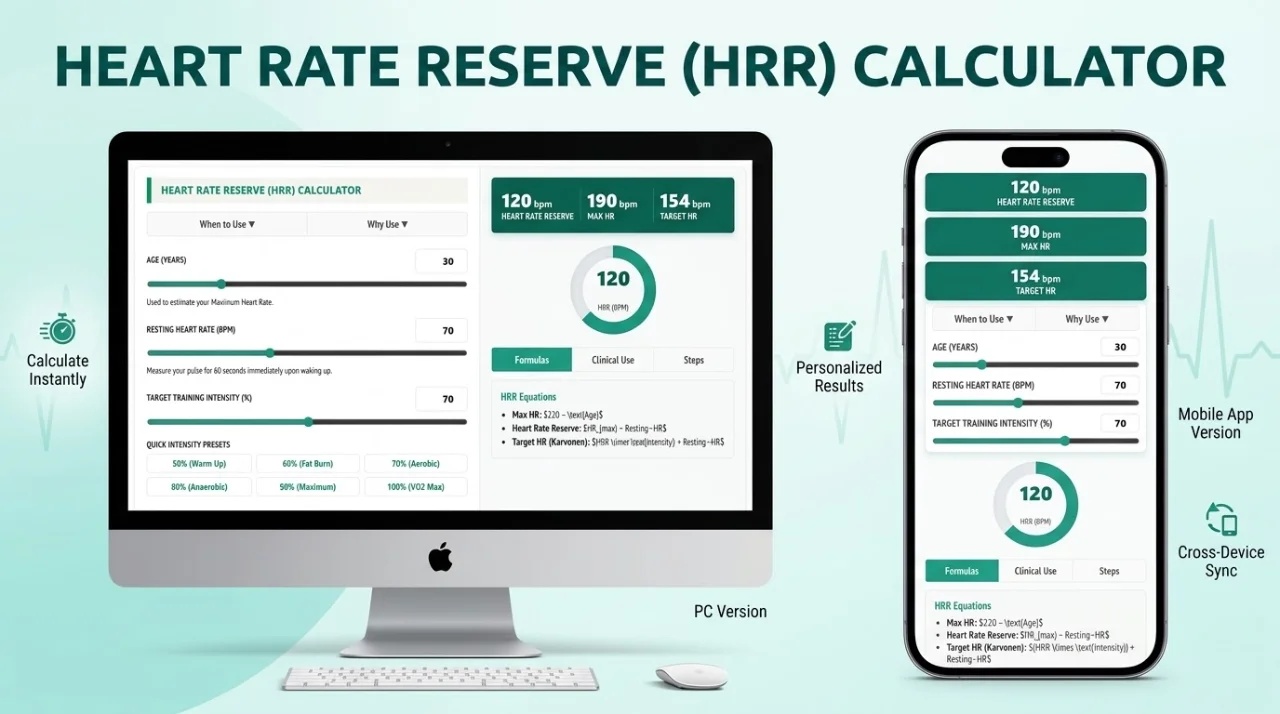
- Providing a baseline number for Target Heart Rate or HRR formulas.
A lower resting heart rate generally implies more efficient heart function and better cardiovascular fitness. Tracking your RHR over time is an excellent indicator of training progress or potential overtraining.
BPM
Calculation Method
- Formula: $\text{Beats Counted} \times \left( \frac{60}{\text{Seconds}} \right)$
- 15-Sec Rule: Multiply beats by 4
- 30-Sec Rule: Multiply beats by 2
When to Measure
For true clinical accuracy, your Resting Heart Rate should be measured immediately upon waking up in the morning, while still lying in bed, before sitting up, moving around, or consuming caffeine.
Understanding the Resting Heart Rate (RHR) Calculator
Your Resting Heart Rate (RHR) is one of the most fundamental, easily accessible metrics for assessing your overall cardiovascular health. It represents the number of times your heart beats per minute (BPM) while your body is at complete rest. By using a Resting Heart Rate Calculator, you can quickly convert short pulse counts into an accurate BPM baseline to track your fitness over time.
Why is Resting Heart Rate Important?
Your RHR provides a direct window into the efficiency of your heart muscle. A well-conditioned heart (such as that of an endurance athlete) is stronger and can pump more blood with every single contraction. Because it pumps more blood per beat, it doesn’t need to beat as frequently to supply your body with oxygen while at rest.
- Higher RHR: Often associated with lower physical fitness, higher blood pressure, stress, or underlying cardiovascular issues.
- Lower RHR: Generally indicates more efficient heart function and better cardiovascular fitness.
How to Measure Your RHR Accurately
To get a true resting baseline, you must eliminate physical and environmental stressors. The golden rule of clinical measurement is to take your pulse first thing in the morning.
- Keep a stopwatch or your phone next to your bed.
- Upon waking up, remain lying down in a relaxed state.
- Find your pulse on your radial artery (the inside of your wrist, below your thumb) or your carotid artery (the side of your neck) using your index and middle fingers. Do not use your thumb, as it has its own slight pulse.
- Count the beats for a specific duration (10, 15, 30, or 60 seconds).
The Calculation Formula
If you don’t want to count for a full 60 seconds, you can count for a shorter duration and use a multiplier. The standard mathematical formula is:
Resting Heart Rate Equation: $$RHR = \text{Beats Counted} \times \left( \frac{60}{\text{Duration in seconds}} \right)$$
Common Multipliers:
- 10-Second Count: Multiply the beats by 6.
- 15-Second Count: Multiply the beats by 4. (Most common clinical method)
- 30-Second Count: Multiply the beats by 2.
RHR Clinical Classifications
Once you have calculated your BPM, you can classify it based on standard clinical guidelines for adults:
| Classification | Heart Rate (BPM) | Clinical Notes |
|---|---|---|
| Bradycardia | < 60 BPM | Considered a slow heart rate. Very common and healthy in well-trained athletes. However, in sedentary individuals, it may cause dizziness or indicate an electrical heart block. |
| Normal | 60 – 100 BPM | The standard, healthy resting heart rate for the vast majority of the adult population. |
| Tachycardia | > 100 BPM | Considered a fast resting heart rate. Can be caused by anxiety, fever, dehydration, caffeine, medications, or underlying cardiac arrhythmias. |
Factors That Affect Your Resting Heart Rate
Even if you are perfectly healthy, your RHR will fluctuate day to day based on several variables. An unexpected spike in your morning RHR is often a primary indicator that you need a rest day.
- Overtraining: A sudden increase of 5–10 bpm over your normal baseline is a classic sign that your nervous system is fatigued from intense workouts.
- Dehydration: When you are dehydrated, your blood volume drops. Your heart must beat faster to maintain blood pressure and oxygen delivery.
- Stress and Sleep: Poor sleep quality and high psychological stress elevate cortisol and adrenaline, increasing your baseline pulse.
- Temperature: In hot, humid weather, your heart rate increases to pump blood to your skin’s surface to cool your body down.
Evidence and References
- Normal Sinus Rhythm and Resting Heart Rate – StatPearls
- All About Heart Rate (Pulse) – American Heart Association