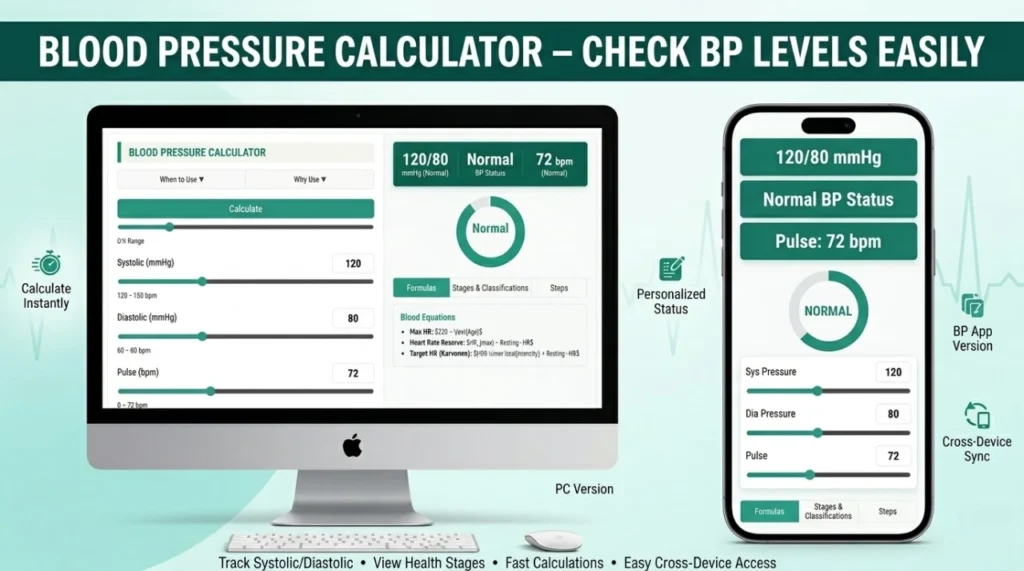
BLOOD PRESSURE CALCULATOR – CHECK BP LEVELS EASILY
- Assessing cardiovascular health based on AHA (American Heart Association) guidelines.
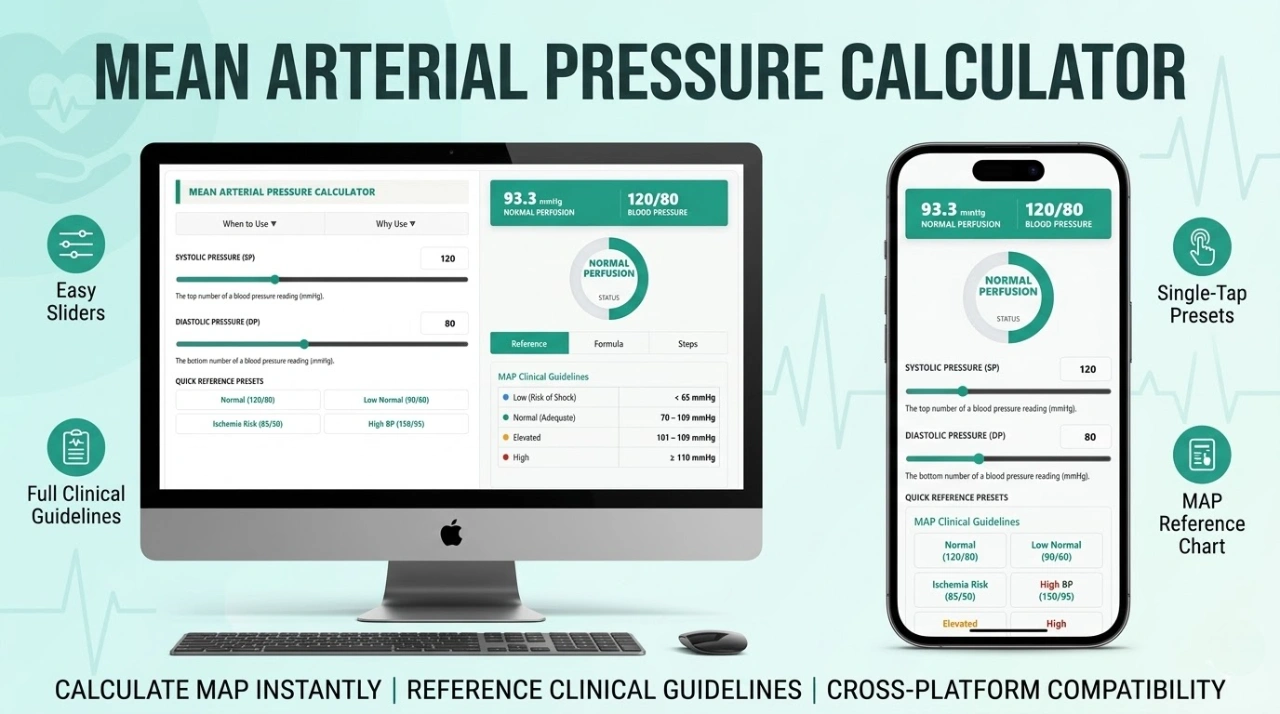
- Calculating clinical hemodynamics like Mean Arterial Pressure (MAP) and Pulse Pressure.
Beyond simply categorizing hypertension, calculating your MAP and Pulse Pressure provides deeper insight into organ perfusion and arterial stiffness.
Category
AHA Guidelines
| Normal | < 120 and < 80 |
| Elevated | 120-129 and < 80 |
| Stage 1 | 130-139 or 80-89 |
| Stage 2 | 140-180 or 90-120 |
| Crisis | > 180 or > 120 |
Clinical Formulas
- Pulse Pressure (PP): $Systolic - Diastolic$
- Mean Arterial Pressure (MAP): $DP + \frac{1}{3}(SP - DP)$
Blood Pressure Calculator – Check BP Levels Easily
Blood pressure is one of the most critical vital signs monitored in healthcare. It measures the force of blood pushing against the walls of your arteries as your heart pumps. Using a clinical Blood Pressure Calculator helps categorize your readings according to official guidelines, while also uncovering advanced cardiovascular metrics like Pulse Pressure and Mean Arterial Pressure (MAP).
Systolic vs. Diastolic Pressure
Blood pressure is recorded as two numbers, written as a ratio (e.g., 120/80 mmHg).
- Systolic (Top Number): Measures the pressure in your arteries when your heart muscle contracts and pumps blood.
- Diastolic (Bottom Number): Measures the pressure in your arteries when your heart muscle rests between beats.
Blood Pressure Categories (AHA Guidelines)
The American Heart Association (AHA) and the American College of Cardiology define blood pressure categories as follows:
| Category | Systolic (mmHg) | Diastolic (mmHg) | |
|---|---|---|---|
| Normal | Less than 120 | and | Less than 80 |
| Elevated | 120 – 129 | and | Less than 80 |
| High BP (Stage 1) | 130 – 139 | or | 80 – 89 |
| High BP (Stage 2) | 140 or higher | or | 90 or higher |
| Hypertensive Crisis | Higher than 180 | and/or | Higher than 120 |
Note: If your systolic and diastolic readings fall into two different categories, your correct category is the higher (more severe) of the two.
Advanced Clinical Metrics
Beyond basic categories, our calculator provides two essential hemodynamic values used by physicians in intensive care units and sports medicine:
1. Pulse Pressure (PP)
Pulse pressure is the numerical difference between your systolic and diastolic blood pressure. It is an indicator of arterial stiffness and the force that the heart generates each time it contracts. A normal resting pulse pressure is typically between 40 and 60 mmHg.
Pulse Pressure Equation: $$PP = Systolic - Diastolic$$
2. Mean Arterial Pressure (MAP)
Mean Arterial Pressure (MAP) is the average pressure in a patient's arteries during one cardiac cycle. It is considered a better indicator of perfusion (blood flow) to vital organs than systolic blood pressure alone. A MAP between 70 and 100 mmHg is necessary to supply enough blood to the brain, coronary arteries, and kidneys.
MAP Equation: $$MAP = Diastolic + \frac{1}{3}(Systolic - Diastolic)$$
Evidence and References
- Understanding Blood Pressure Readings - American Heart Association
- Physiology, Mean Arterial Pressure - StatPearls - NCBI
FaQs
What is a blood pressure calculator?
A blood pressure calculator helps you analyze your systolic and diastolic readings to determine if your BP is normal, high, or low.
What do systolic and diastolic mean?
Systolic is the pressure when your heart beats, while diastolic is the pressure when your heart rests between beats.
What is normal blood pressure?
Normal blood pressure is typically around 120/80 mmHg. Values higher or lower may indicate health issues.
What is considered high blood pressure?
High blood pressure (hypertension) is usually when readings are consistently above 130/80 mmHg.
What is low blood pressure?
Low blood pressure (hypotension) is generally considered when readings are below 90/60 mmHg.
How accurate is this blood pressure calculator?
The calculator provides general guidance based on standard ranges, but actual diagnosis should be done by a healthcare professional.