IV INFUSION RATE CALCULATOR
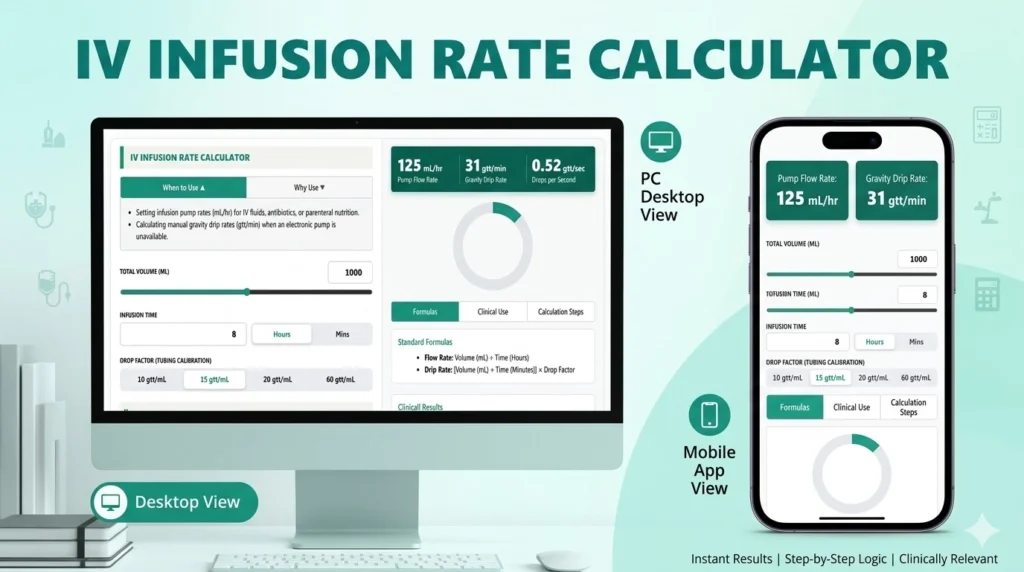
- Setting infusion pump rates (mL/hr) for IV fluids, antibiotics, or parenteral nutrition.
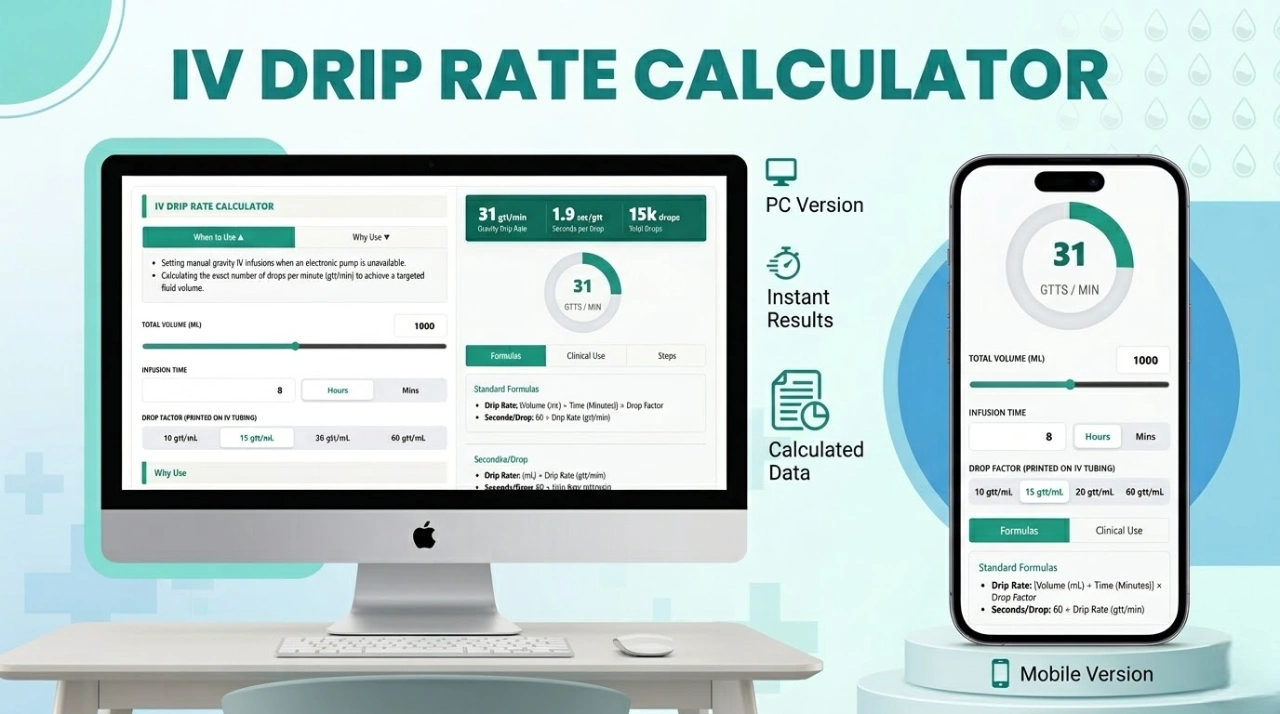
- Calculating manual gravity drip rates (gtt/min) when an electronic pump is unavailable.
Precise infusion rate calculation prevents adverse events such as fluid overload, medication toxicity, or inadequate therapeutic dosing.
per hour
Standard Formulas
- Flow Rate: Volume (mL) ÷ Time (Hours)
- Drip Rate: [Volume (mL) ÷ Time (Minutes)] × Drop Factor
Clinical Context
Use Macrodrip tubing (10, 15, or 20 gtt/mL) for fast infusions or thick fluids. Use Microdrip tubing (60 gtt/mL) for pediatrics, precise titrations, or when strict fluid restriction is required.
Understanding the IV Infusion Rate Calculator
Administering intravenous fluids and medications safely requires pinpoint accuracy. Whether utilizing an electronic infusion pump or setting a manual gravity drip, nurses and healthcare providers rely on exact mathematical calculations. Our IV infusion rate calculator simplifies this process, ensuring accurate dosing for both adult and pediatric patients while minimizing the risk of medical errors.
Flow Rate vs. Drip Rate: What is the Difference?
When calculating IV infusions, clinicians primarily deal with two distinct metrics depending on the equipment available:
- Flow Rate (mL/hr): Used when an electronic infusion pump is available. It determines how many milliliters of fluid enter the patient’s vein every hour.
- Drip Rate (gtt/min): Used for manual gravity infusions. “gtt” stands for guttae (Latin for drops). This tells the nurse how many drops should fall into the drip chamber every minute to achieve the desired total volume.
Standard IV Calculation Formulas
To calculate a manual gravity drip, you must know the Drop Factor of the IV tubing being used. The drop factor refers to the number of drops it takes to equal 1 milliliter (mL) of fluid, and it is always printed on the IV tubing packaging. A reliable IV drip rate calculator applies these standard equations:
Drop Rate (gtt/min):
Volume (mL) Time (min) × Drop Factor = gtt/min.
Hourly Rate (mL/hr):
Total Volume (mL) Time (hr) = mL/hr.
Macrodrip vs. Microdrip Tubing
- Macrodrip Tubing (10, 15, or 20 gtt/mL): Delivers large drops. Used for rapid fluid resuscitation, routine hydration, and adult patients.
- Microdrip Tubing (60 gtt/mL): Delivers tiny drops. Used for pediatric patients, highly potent medications (like vasopressors), and strict fluid restrictions. Note: With 60 gtt/mL tubing, the drip rate (gtt/min) is always exactly equal to the flow rate (mL/hr).
Example Calculation
Scenario: A doctor orders 1,000 mL of Normal Saline to infuse over 8 hours. The available IV tubing has a drop factor of 15 gtt/mL.
| Metric | Calculation Step | Result |
|---|---|---|
| Flow Rate (Pump) | 1,000 mL ÷ 8 Hours | 125 mL/hr |
| Time Conversion | 8 Hours × 60 Minutes | 480 Minutes |
| Total Drops | 1,000 mL × 15 gtt/mL | 15,000 Drops |
| Drip Rate (Gravity) | 15,000 Drops ÷ 480 Minutes | 31 gtt/min |
Important Clinical Considerations
When utilizing any IV infusion rate calculator in a clinical setting, keep the following safety guidelines in mind:
- Rounding: Electronic pumps can often be set to the tenth of a decimal (e.g., 12.5 mL/hr), but manual gravity drips must be rounded to the nearest whole drop (you cannot count half a drop).
- Fluid Viscosity: Thick fluids like packed red blood cells (PRBCs) drop differently than thin fluids like Normal Saline. Always follow institutional policies for blood transfusions.
- Patient Monitoring: Gravity drips can speed up or slow down based on patient movement, the height of the IV pole, or venous pressure. Frequent visual reassessment is mandatory.
Evidence and References
- Intravenous Fluid Therapy – StatPearls – NCBI Bookshelf
- Medical Math & Clinical Calculations – StatPearls – NCBI Bookshelf
FAQs
What is an IV infusion rate calculator?
An IV infusion rate calculator is a tool used to determine the correct flow rate of intravenous fluids in mL per hour or drops per minute.
How do you calculate IV infusion rate?
The IV infusion rate is calculated using the formula:
(Volume × Drop Factor) ÷ Time to get drops per minute (gtt/min).
What is the difference between mL/hr and gtt/min?
mL/hr measures fluid delivery per hour (used in infusion pumps), while gtt/min measures drops per minute (used in manual IV setups).
Who should use an IV infusion rate calculator?
Nurses, doctors, paramedics, and medical students use this calculator to ensure accurate and safe fluid administration.
What is the formula for drip rate (gtt/min)?
Drip Rate = (Total Volume in mL × Drop Factor) ÷ Time (in minutes).