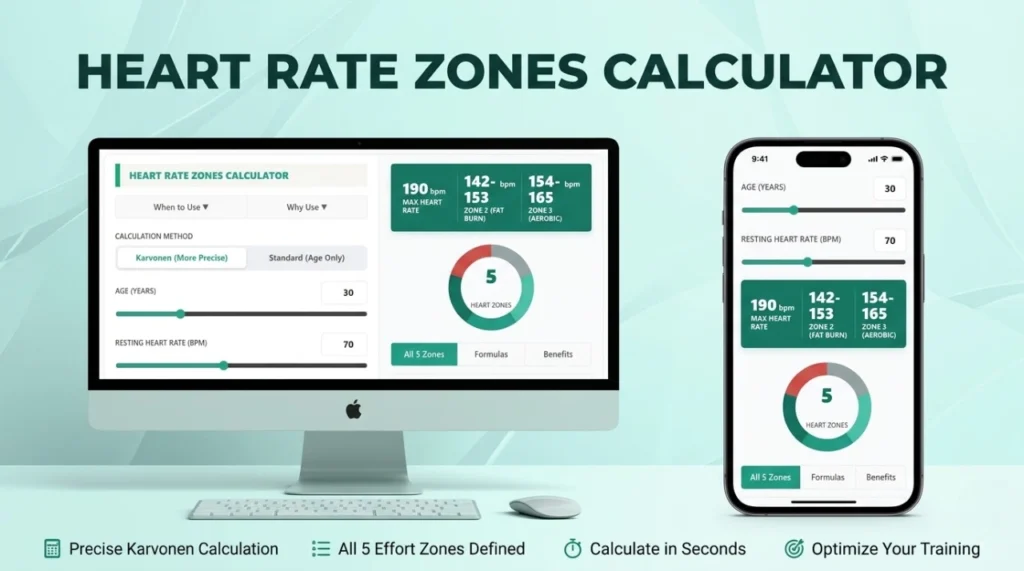
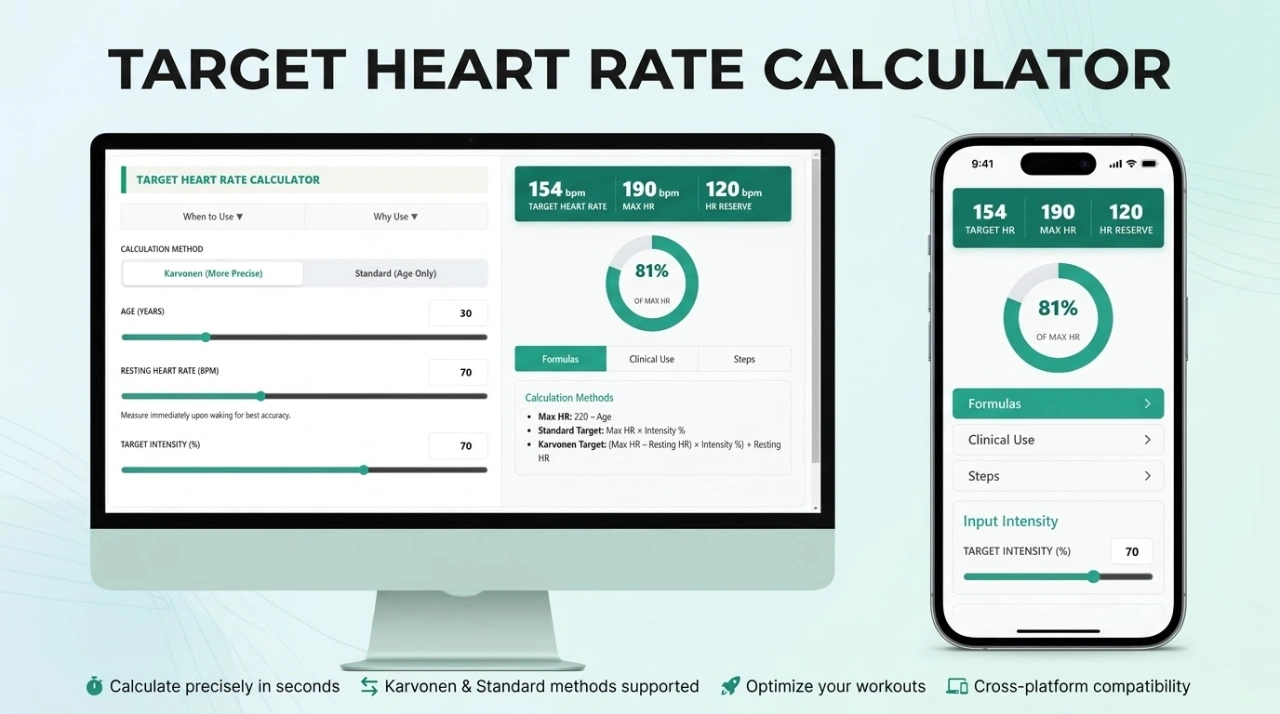
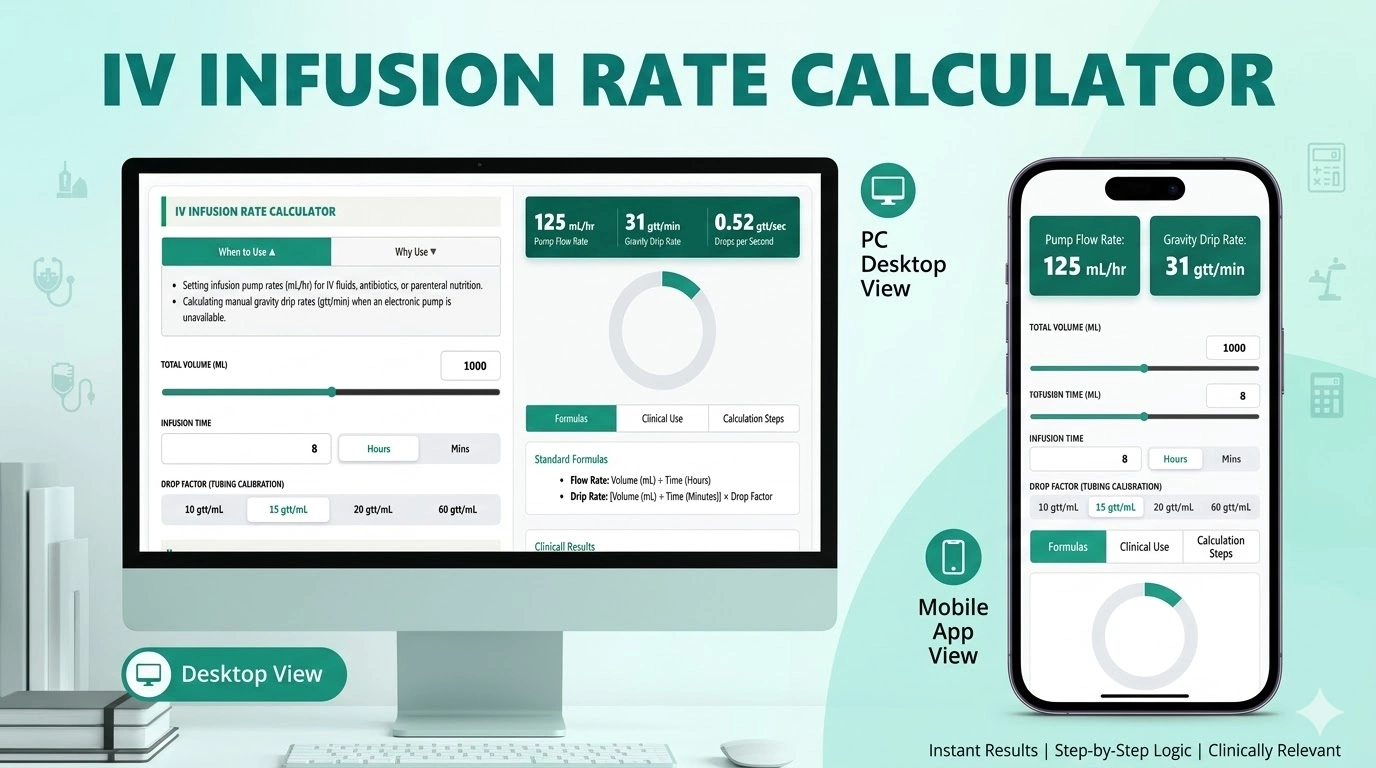
HEART RATE ZONES CALCULATOR
- Planning cardiovascular training (e.g., endurance vs. HIIT).
- Ensuring you stay in the “Fat Burn” or “Aerobic” zone for specific health goals.
Training in the correct zone ensures you don’t overtrain your heart while maximizing metabolic and aerobic benefits. The Karvonen method provides the highest clinical accuracy.
Heart Zones
| Zone | Intensity | Target BPM |
|---|
Calculation Methods
- Max HR: 220 – Age
- Standard Method: Max HR × Intensity %
- Karvonen Method: ((Max HR – Resting HR) × Intensity %) + Resting HR
Zone Benefits
Z1 & Z2: Builds base endurance and burns fat.
Z3: Improves cardiovascular efficiency.
Z4: Raises lactate threshold (hard breathing).
Z5: Maximum performance (sprints/HIIT).
Understanding the Heart Rate Zones Calculator
Whether you are training for a marathon, aiming to burn stubborn body fat, or undergoing cardiac rehabilitation, exercising at the correct intensity is paramount. A clinical Heart Rate Zones Calculator allows you to map out your cardiovascular capacity into 5 distinct training zones, ensuring every workout is perfectly tailored to your physiological limits and fitness goals.
The 5 Heart Rate Training Zones
Heart rate zones are ranges of heartbeats per minute (BPM) that correspond to different levels of exertion. As your heart rate increases, your body utilizes different energy systems.
- Zone 1: Warm Up (50% – 60% of Max HR): Very light intensity. Ideal for warming up, cooling down, and active recovery. Your body easily supplies oxygen to your muscles.
- Zone 2: Fat Burn / Basic Endurance (60% – 70% of Max HR): Light intensity. You should be able to hold a conversation comfortably. In this zone, your body optimizes its ability to burn stored fat for fuel.
- Zone 3: Aerobic / Cardio (70% – 80% of Max HR): Moderate intensity. This zone heavily improves your cardiovascular and pulmonary efficiency. Lactic acid begins to build up, but your body can still clear it.
- Zone 4: Anaerobic / Hard (80% – 90% of Max HR): Hard intensity. Breathing is heavy. Training in this zone increases your lactate threshold, allowing you to perform at higher intensities for longer durations.
- Zone 5: VO2 Max / Maximum Effort (90% – 100% of Max HR): Maximum intensity. This zone is only sustainable for very short bursts (e.g., HIIT sprints) and is used to increase fast-twitch muscle power and peak athletic performance.
Standard Method vs. Karvonen Formula
When calculating your zones, you must choose a mathematical model. Our calculator provides the two most widely accepted clinical standards:
The Standard Method (Age-Based)
This is the most common approach. It estimates your Maximum Heart Rate (Max HR) by subtracting your age from 220, and then simply multiplies that number by the zone percentages.
Standard Target HR = (220 – Age) × Intensity %
Alternative Method (More Precise)
The Standard method assumes all people of the same age have the same fitness level, which is clinically inaccurate. For more personalized zones, use the Karvonen formula, which incorporates your resting heart rate (RHR) to find your Heart Rate Reserve (HRR). Because a fit athlete has a lower resting heart rate than a sedentary person, the Karvonen formula provides highly tailored, precise training zones.
Karvonen Target HR = ((Max HR – Resting HR) × Intensity %) + Resting HR
General Running Heart Rate Tips
- Resting Heart Rate (RHR): A normal resting rate is 60-100 bpm. Measure this immediately upon waking up for the most accurate baseline.
- Safety: Always consult a doctor before beginning high-intensity training (Zones 4 & 5), especially if you have an underlying cardiac condition.
- Factors: Heat, humidity, dehydration, and physical fatigue can artificially increase your heart rate during a run, even if your physical pace is low. Listen to your body and adjust your zones accordingly.
Evidence and References
- Cardiovascular Adaptations to Exercise – StatPearls – NCBI Bookshelf
- Normal Sinus Rhythm and Resting Heart Rate – StatPearls