TARGET HEART RATE CALCULATOR
- Determining safe and effective heart rate targets for cardiovascular exercise.
- Prescribing specific exertion levels for cardiac rehabilitation patients.
Exercising at the correct target heart rate ensures you maximize cardiovascular benefits (like fat burn or endurance) without dangerously overstressing the heart muscle.
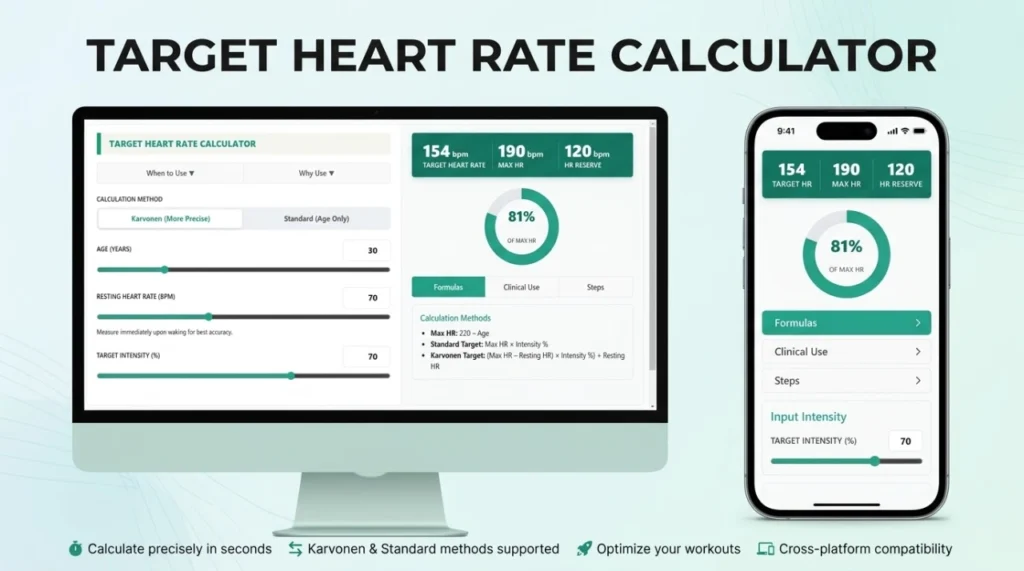
of Max HR
Calculation Methods
- Max HR: 220 - Age
- Standard Target: Max HR × Intensity %
- Karvonen Target: ((Max HR - Resting HR) × Intensity %) + Resting HR
Method Differences
The Standard method is a quick age-based estimate. The Karvonen Method is clinically preferred because it factors in your resting heart rate (a key indicator of cardiovascular fitness) to provide a truly personalized exertion zone.
Understanding the Target Heart Rate Calculator
Monitoring your heart rate during physical activity is one of the most effective ways to ensure you are exercising safely and achieving your specific fitness or rehabilitation goals. Using a clinical Target Heart Rate Calculator allows healthcare providers, personal trainers, and patients to pinpoint the exact beats per minute (BPM) required to improve cardiovascular endurance without overstressing the heart muscle.
Standard Method vs. Karvonen Formula
There are two primary methods used to calculate your target heart rate. While both use your age as a baseline, one is significantly more accurate for tailored fitness plans.
1. The Standard Method (Age-Based)
Many people are familiar with the basic maximum heart rate equation: 220 minus your age. To find your target heart rate using this standard method, you simply multiply that maximum number by your desired intensity percentage.
Standard Target HR = (220 - Age) × Intensity %
While easy to calculate, this simplistic formula has a major clinical flaw: it does not account for an individual's baseline fitness level. Two 40-year-olds have the exact same predicted standard target heart rate, even if one is an elite athlete and the other is entirely sedentary.
2. The Karvonen Formula (Heart Rate Reserve)
To solve the limitations of the standard method, physiologists use the Karvonen Formula. This equation introduces your Resting Heart Rate (RHR) into the calculation to determine your Heart Rate Reserve (HRR). Because a physically fit person generally has a lower resting heart rate, incorporating this metric provides a highly personalized target heart rate zone.
The Karvonen Equation:
1. Max HR = 220 - Age
2. HRR (Heart Rate Reserve) = Max HR - Resting HR
3. Target Heart Rate = (HRR × Intensity %) + Resting HR
Choosing Your Target Intensity (%)
Depending on your clinical or fitness goals, you will aim for different intensity percentages. Here are the standard recognized zones:
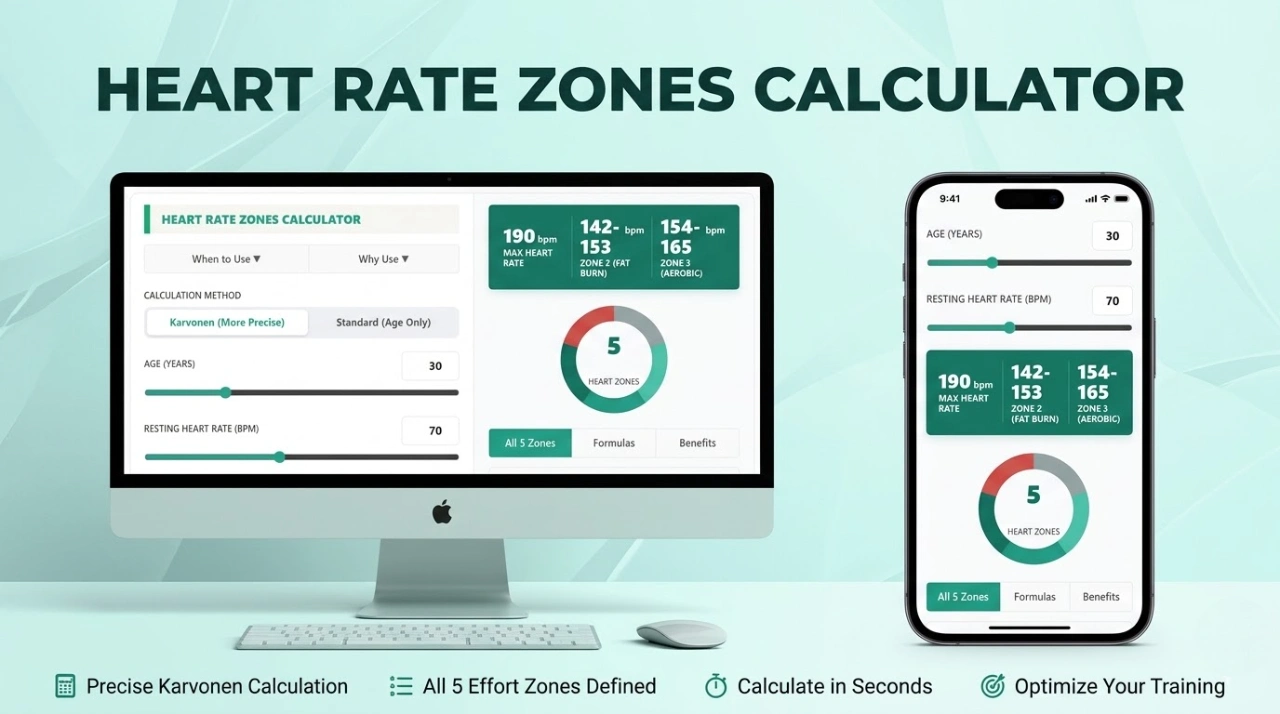
[Image of Target Heart Rate Zones chart]- 50% - 60% (Warm Up / Recovery): Best for beginners, warming up, or active recovery. Very low stress on the cardiovascular system.
- 60% - 70% (Fat Burn / Basic Endurance): Improves basic endurance. In this aerobic zone, your body optimizes its ability to utilize stored fat for energy.
- 70% - 80% (Aerobic / Cardio): The optimal zone for improving cardiovascular fitness, lung capacity, and overall physical stamina.
- 80% - 90% (Anaerobic / Hardcore): High-intensity training. Best for increasing your lactate threshold and explosive athletic performance.
- 90% - 100% (VO2 Max): Maximum effort, usually only sustainable for very short bursts (e.g., HIIT sprints).
Example Target Heart Rate Calculation
Scenario: A 30-year-old patient with a resting heart rate of 70 BPM wants to exercise at a 70% aerobic intensity using the precise Karvonen method.
| Metric | Calculation Step | Result |
|---|---|---|
| Find Max HR | 220 - 30 | 190 BPM |
| Find HR Reserve (HRR) | 190 (Max HR) - 70 (Resting HR) | 120 BPM |
| Apply Intensity (70%) | 120 × 0.70 | 84 BPM |
| Final Target HR | 84 + 70 (Resting HR) | 154 BPM |
Important Clinical Considerations
While target heart rate formulas are highly effective, there are clinical factors that can alter safe training zones:
- Medications: Beta-blockers (e.g., Metoprolol, Atenolol) artificially lower both resting and maximum heart rates. The standard 220-age formula is invalid for patients on these medications.
- Cardiac Rehab: Patients recovering from myocardial infarction or cardiac surgery should only exercise within strictly prescribed zones determined by a clinical exercise stress test, not general formulas.
- Perceived Exertion: Formulas are mathematical estimates. Clinicians often pair heart rate monitoring with the Borg Rating of Perceived Exertion (RPE) scale to gauge a patient's true physical tolerance.
Evidence and References
- Cardiovascular Adaptations to Exercise - StatPearls - NCBI Bookshelf
- Heart Rate Reserve and Target Heart Rate Methodologies - NIH