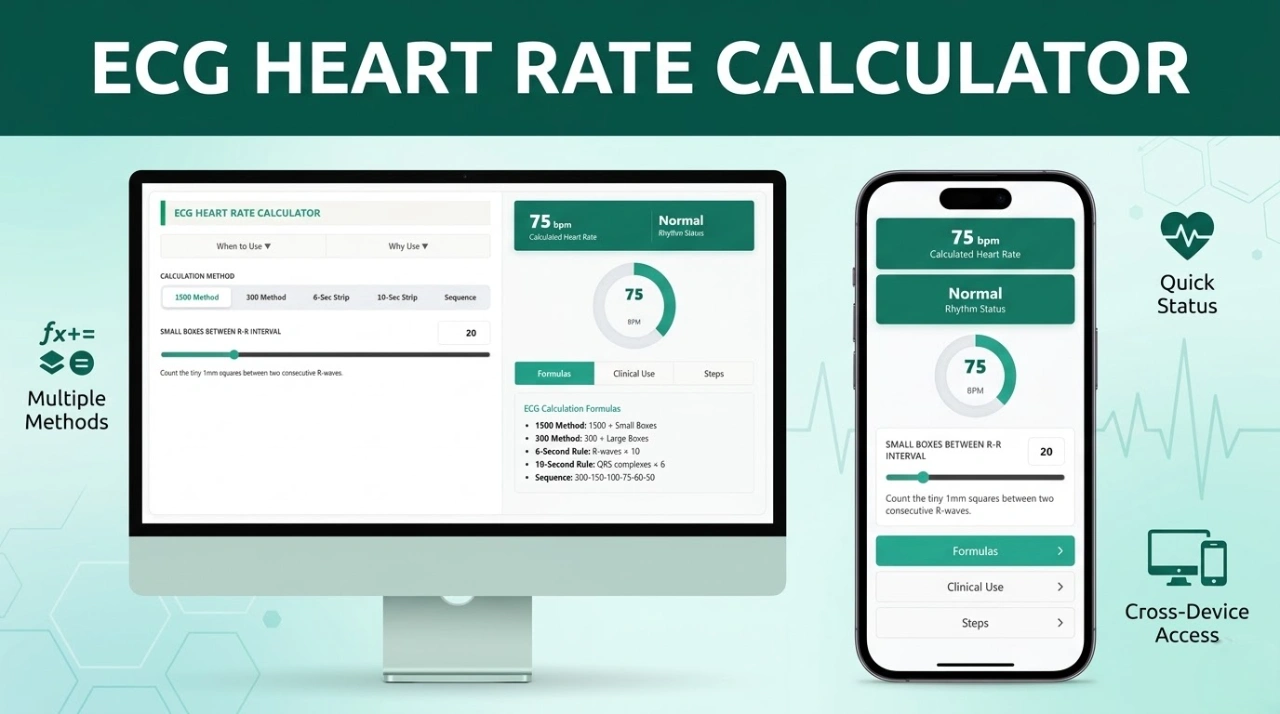
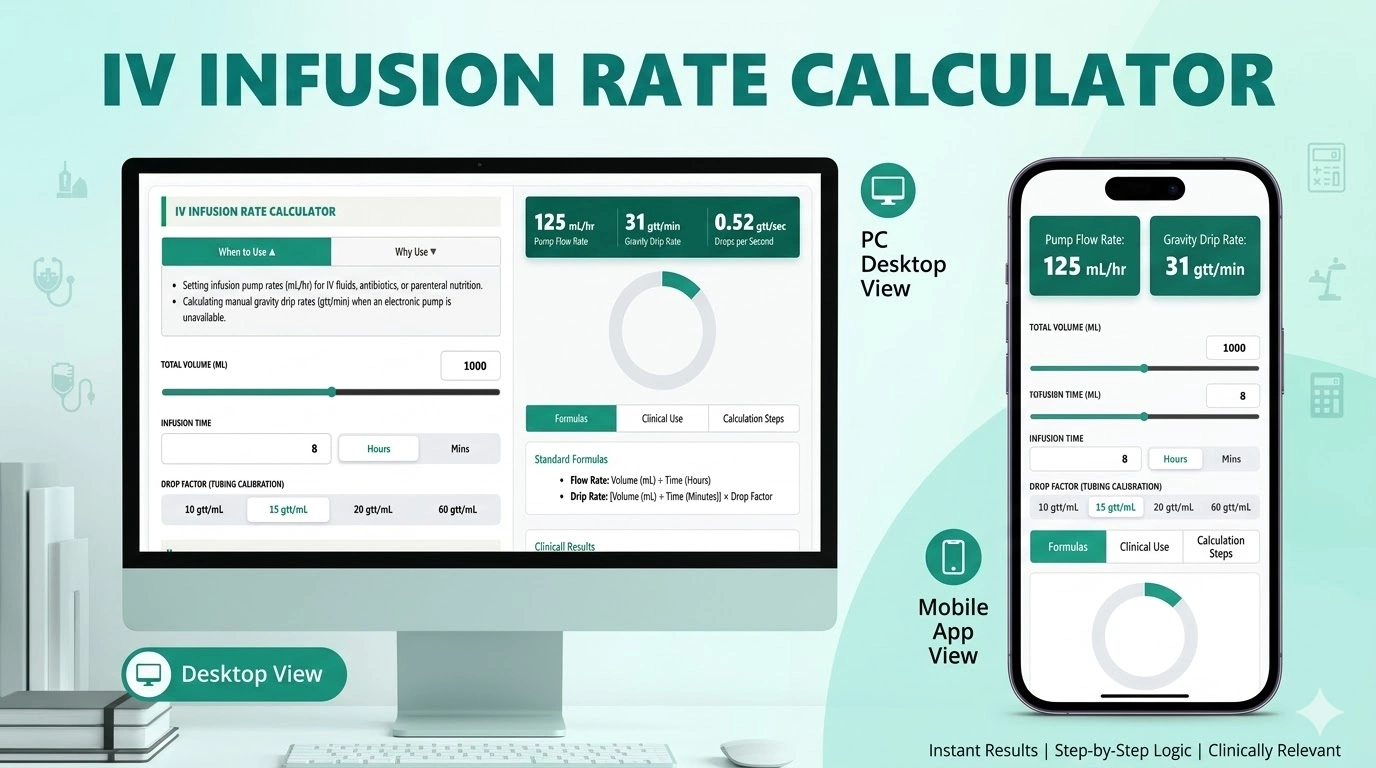
THE 300 RULE ECG CALCULATOR (Triplicate Method)
- Rapidly estimating a patient's heart rate directly from a printed ECG/EKG strip.
- Quickly identifying Bradycardia or Tachycardia in regular rhythms.
The 300 Rule (or Sequence Method) is the fastest manual calculation available to clinicians for regular heart rhythms, requiring almost zero complex math at the bedside.
BPM
The 300 Equation
- Heart Rate: $300 \div \text{Number of Large Boxes}$
- Standard Speed: Assumes the ECG paper is moving at 25 mm/sec.
Important Warning
The 300 rule is highly effective, but it cannot be used for irregular rhythms (like Atrial Fibrillation). For irregular rhythms, you must use the 6-Second Strip method.
What is the 300 Rule on an ECG?
In clinical environments, quickly interpreting an electrocardiogram (ECG or EKG) can be critical for patient care. While automated monitors provide digital heart rate readouts, they are prone to artifact interference or misinterpreting tall T-waves as QRS complexes. Therefore, healthcare providers must know how to calculate a patient's heart rate manually. The 300 Rule (also known as the Big Box method) is the most common and rapid way to do this.
How the 300 Rule Works
Standard ECG paper runs through the machine at a constant speed of 25 millimeters per second. Because the speed is standardized, the grid boxes printed on the paper perfectly correspond to fractions of a second.
- Every tiny 1mm box equals 0.04 seconds.
- Every large 5mm box (which contains 5 small boxes) equals 0.20 seconds.
Since there are 60 seconds in a minute, if you divide 60 seconds by 0.20 seconds, you get 300. This means exactly 300 large boxes print out every single minute.
The Calculation Formula
To find the heart rate in beats per minute (BPM), you simply count the number of large boxes between two consecutive R-waves (the tall peaks of the QRS complex, known as the R-R interval) and divide 300 by that number.
The 300 Rule Equation: $$HR = \frac{300}{\text{Number of Large Boxes}}$$
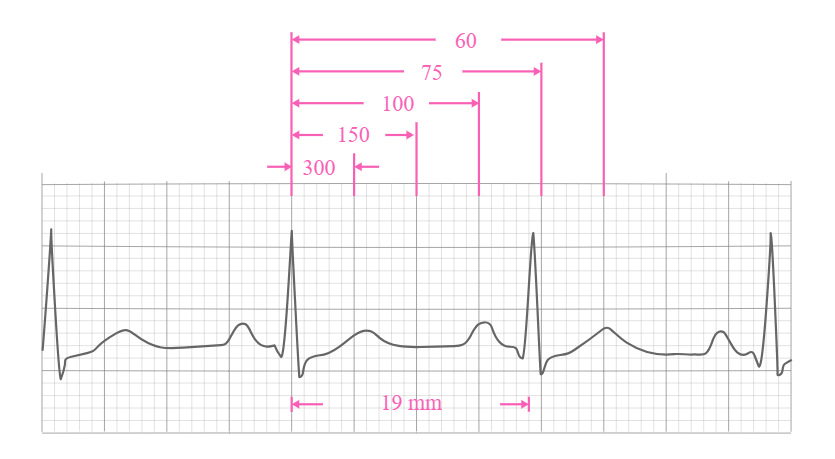
The Sequence Method (Memorization)
Because the math is so simple, most clinicians just memorize the resulting sequence rather than doing division in their heads. If an R-wave lands exactly on a heavy line, you can simply point to the subsequent heavy lines and count down the sequence until the next R-wave hits:
- 1 Box: 300 bpm
- 2 Boxes: 150 bpm
- 3 Boxes: 100 bpm
- 4 Boxes: 75 bpm
- 5 Boxes: 60 bpm
- 6 Boxes: 50 bpm
Clinical Limitations: When NOT to Use the 300 Rule
It is vital to understand that the 300 Rule only works for regular heart rhythms. If the distance between R-waves is consistent, the 300 Rule is highly accurate.
However, if a patient has an irregular rhythm (such as Atrial Fibrillation, Premature Ventricular Contractions (PVCs), or a varying heart block), the distance between R-waves constantly changes. Using the 300 Rule on an irregular strip will result in a completely false calculation. For irregular rhythms, clinicians must use the 6-Second Strip Method (counting total R-waves in a 6-second window and multiplying by 10).
Evidence and References