Decrease 3 by 10% Calculator
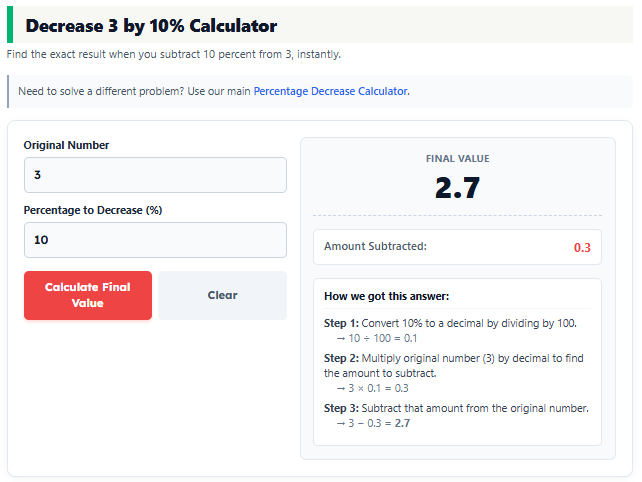
Find the exact result when you subtract 10 percent from 3, instantly.
Final Value
0
Amount Subtracted:
0
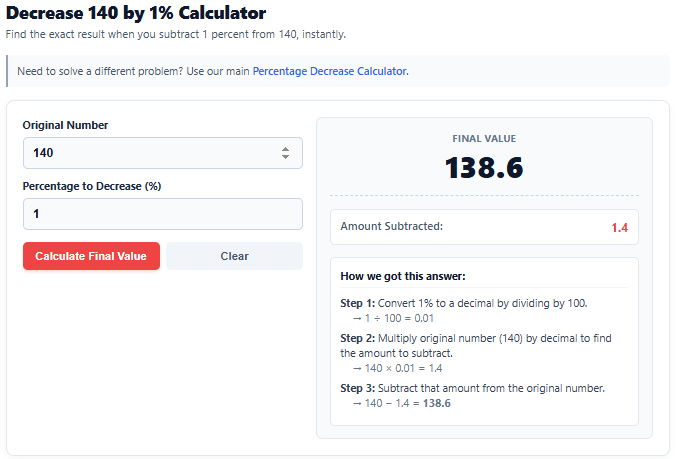
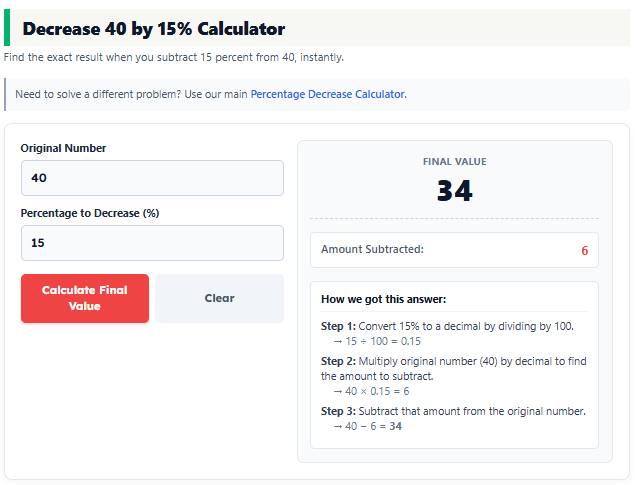
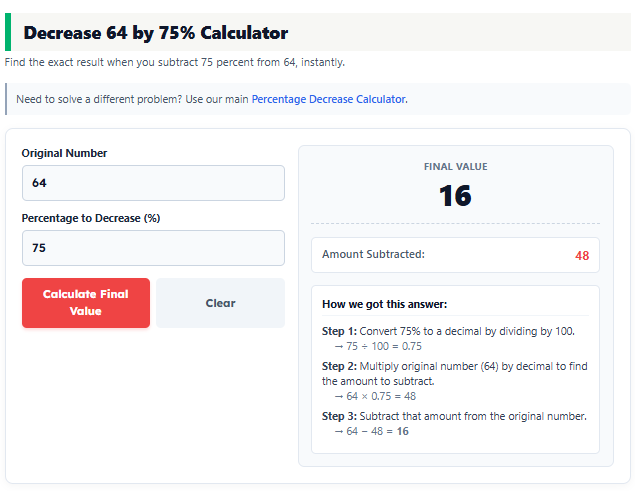
How we got this answer:
Try our other specific calculators:
How to Decrease 3 by 10%
Decreasing a number by a percentage is a standard mathematical process used to calculate small reductions, statistical tolerances, and discounts. If you need to find out what 3 minus 10% equals, the process requires two simple steps: finding the actual decimal value of 10%, and then subtracting it from your starting number.
Step-by-Step Calculation Example
Let’s break down the exact math used by the calculator to solve 3 decreased by 10%:
- Convert the percentage to a decimal: You do this by dividing the percentage by 100.
10 ÷ 100 = 0.1 - Multiply by the original number: Multiply 3 by the decimal to find out exactly how much “10%” is in real numbers.
3 × 0.1 = 0.3 - Subtract that value from the original number: Take your 0.3 and subtract it from the starting 3.
3 − 0.3 = 2.7
Therefore, decreasing 3 by 10 percent results in exactly 2.7.
The Universal Formula
If you want to solve this kind of problem on a standard handheld calculator, you can use the following formula:
Final Value = Original Number − (Original Number × (Percentage / 100))
Reference Table: Subtracting 10%
If you are calculating moderate reductions, it helps to see how a 10% decrease affects other common numbers. Here is a quick reference chart:
| Original Amount | Value of 10% | Final Reduced Result |
|---|---|---|
| 3 | 0.3 | 2.7 |
| 10 | 1.0 | 9 |
| 50 | 5.0 | 45 |
| 100 | 10.0 | 90 |
| 200 | 20.0 | 180 |
How to Use the Decrease 3 by 10% Calculator
- Enter the Original Number
Type the starting value in the Original Number field (for example, 3). - Enter the Percentage to Decrease
Enter the percentage you want to reduce (for example, 10). - Click “Calculate Final Value”
Press the Calculate button to perform the calculation. - View the Result
The calculator will instantly show the final value after the decrease and the amount reduced.